






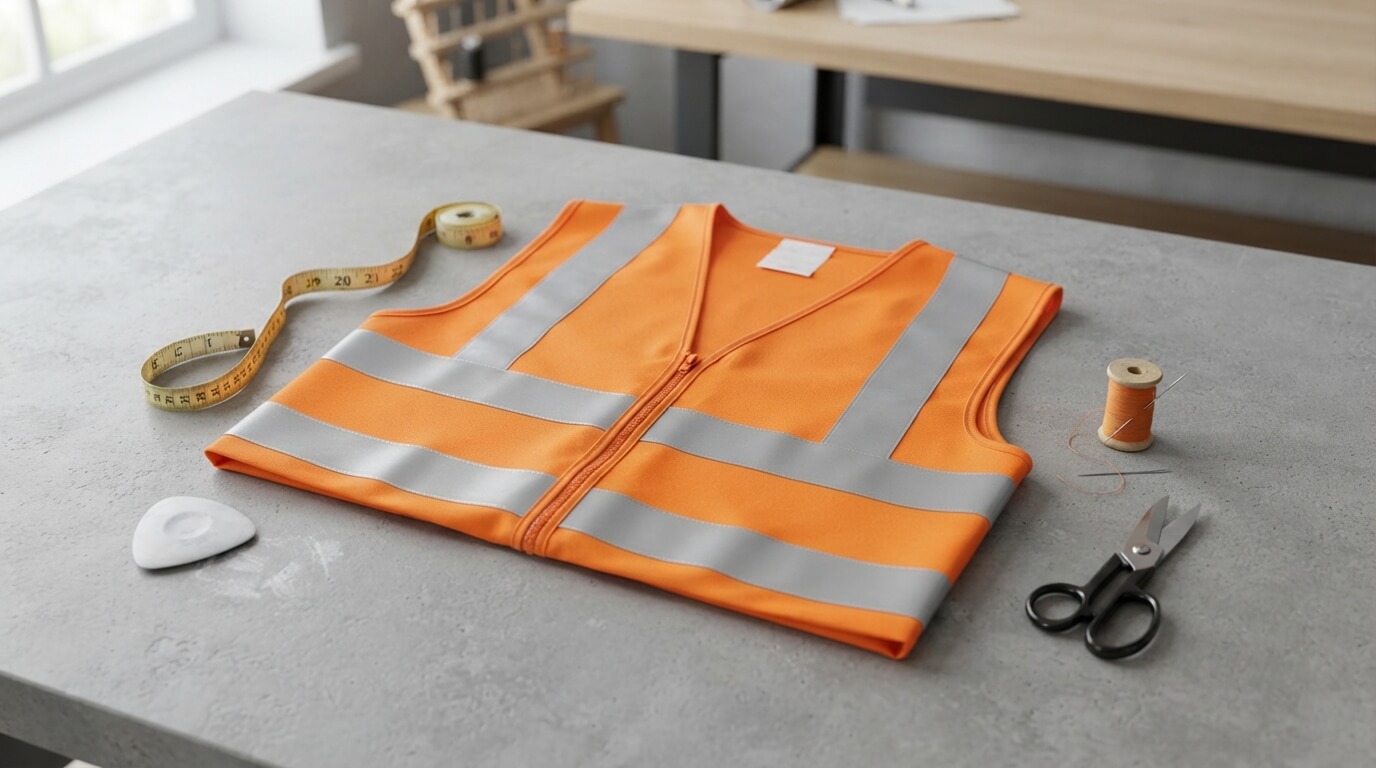
You ordered a safety vest, it arrived, and it’s a size too big. Before you reach for a hot wash cycle hoping to shrink it down, there are a few things you need to know — because done wrong, shrinking a hi-vis vest can void its compliance with AS/NZS 4602.1 and leave you with a vest that’s technically unusable on an Australian worksite.
This guide covers exactly what happens when you try to shrink a polyester or poly-cotton safety vest, which methods are safe (and which will damage the reflective tape or fluorescent fabric), and — honestly — why ordering the right size from the start is nearly always the better path.
Why Safety Vests Often Run Large
The most common reason people search for how to shrink a safety vest is simple: the size they ordered didn’t fit. This happens more than you’d think, and there are a few reasons why.
Safety vests are designed to be worn over other clothing — hi-vis shirts, bulky winter layers, or in some cases, fall arrest harnesses. The sizing standards take this into account, so vests are intentionally cut with extra room. If you’re comparing them to a regular work shirt, they’ll feel a full size or two larger.
There’s also inconsistency between manufacturers. One brand’s XL is another’s 2XL. And many lower-cost vests sourced from overseas markets run particularly large compared to Australian sizing expectations.
Before trying to shrink anything, it’s worth checking whether you simply need a different size or a different cut — for example, women’s fit safety vests are designed more narrowly through the torso and can be a much better solution than trying to alter a unisex garment.
Can You Actually Shrink a Safety Vest?
The honest answer: yes, a little — but probably not as much as you need, and the process carries real risks.
The fabric problem
The vast majority of Australian safety vests are made from 100% polyester or a poly-cotton blend. Polyester is chosen specifically because it holds its fluorescent colour (the yellow-green or orange-red you see on compliant vests) far better than natural fibres under UV exposure and repeated washing.
The downside is that polyester has very low shrink potential. Even with aggressive heat, a polyester vest will typically shrink 3–5% at most — less than half a size. A poly-cotton blend (usually 65% polyester / 35% cotton) has slightly more give because of the cotton component, but still won’t drop a full size.
If your vest is two sizes too big, no washing method will fix that. If it’s borderline — say the chest fits but it hangs too long — you might achieve a small improvement.
| ⚠️ Important Any shrinkage also affects the reflective tape configuration. If the garment body shrinks but the tape doesn’t (reflective tape is dimensionally stable), it can bunch, peel, or shift out of the minimum-area placement required under AS/NZS 4602.1. |
How to Shrink a Safety Vest: Step-by-Step
If you’ve weighed up the compliance risks and still want to try, here’s the safest approach for a poly-cotton blend vest. This method is not recommended for 100% polyester vests, as the result will be minimal and the risk of tape damage is the same.
Method 1 — Warm machine wash (least risky)
- Turn the vest inside-out before washing. This limits direct friction on the reflective tape.
- Set your machine to a warm wash — 40 °C maximum. Hot washes above 60 °C begin to stress the retroreflective tape laminate.
- Use a gentle cycle, not a heavy-duty setting.
- Use a mild, non-bleach detergent. Optical brighteners found in some laundry powders can interfere with fluorescent pigments over time.
- Remove promptly when the cycle ends. Don’t leave a wet safety vest bunched up — this sets creases and can distort tape placement.
- Hang to dry in the shade. Avoid direct sunlight for extended drying periods as UV exposure degrades fluorescent fabric.
Method 2 — Controlled tumble dry (slightly more shrinkage, more risk)
- Wash first using Method 1 above.
- Tumble dry on LOW heat only — never medium or high.
- Check every 10 minutes. You’re looking for slight tightening of the fabric, not a full dry cycle.
- Remove while still slightly damp and hang to finish drying. This prevents over-shrinking and tape delamination.
- Once fully dry, lay the vest flat and check that all reflective tape is still flat, adhered, and undistorted.
| 📋 Post-wash compliance check After any heat treatment, inspect the vest before it goes back into use. Tape should lie flat with no bubbling, peeling at edges, or visible creasing. Hold it up to light — the fluorescent panel should be even in colour with no faded patches. If any of these issues are present, the vest should be replaced. |
What You Should Never Do When Trying to Shrink a Hi-Vis Vest
The following methods are commonly suggested online for shrinking clothing — but they are damaging to safety vests specifically, and in most cases will render the vest non-compliant.
| Method to avoid | Why it causes problems |
| Boiling water (100 °C) | Destroys fluorescent pigment — vest fails luminance test |
| Iron / steam press | Melts retroreflective tape — loses compliance immediately |
| Bleach or solvent | Breaks down fluorescent dye, may weaken fibres |
| Commercial dryer (high) | Delaminate reflective tape, shrinks unevenly, distorts fit |
| Leaving in hot car | Prolonged UV + heat accelerates fading — not the same as shrinking but equally damaging |
When Shrinking Voids Your AS/NZS 4602.1 Compliance
This is the part most people don’t think about. Under AS/NZS 4602.1:2011 (and the 2024 update), a compliant safety vest must meet specific requirements for:
- Minimum fluorescent fabric area — the amount of fluorescent material visible on the garment
- Retroreflective tape placement and minimum area — specific distances, configurations, and total tape area by class (D, D/N, or R)
- Luminance factor — how bright the fluorescent colour appears in daylight conditions
- Retroreflectivity — the measured performance of the tape when light hits it
When you apply heat to shrink a vest, the fabric panels contract. The retroreflective tape, which is laminated to the fabric, does not contract at the same rate. This can cause:
- Tape to buckle, creating folds that reduce effective retroreflective area
- Tape adhesive to delaminate from the fabric, causing peeling
- The tape’s position on the garment to shift, potentially falling short of the minimum geometric configuration required
- The fluorescent fabric to lose some luminance if exposed to excessive heat
A vest that no longer meets these specifications — even if it looks intact to the naked eye — is non-compliant. Using a non-compliant vest on an Australian worksite where hi-vis is required can expose both the worker and their employer to WHS liability. Read more: Non-compliant safety vests: risks and legal liability for Australian employers
| 🔍 Bottom line on compliance If you’ve shrunk your vest and are unsure whether it’s still compliant, don’t risk it. A replacement vest is far cheaper than the consequences of a worksite injury or a WHS penalty notice. |
The Better Solution: Order the Right Size From the Start
We get it — sizing a safety vest online feels like a gamble. But taking two measurements and comparing them to a size chart takes less than two minutes and gets you the right fit first time, every time.
How to measure for a safety vest
You need two measurements: chest circumference and, if length matters for your role, your torso length.
- Chest measurement: Stand with arms slightly out. Wrap a tape measure around the fullest part of your chest, just under your arms. Keep it level and snug but not tight. Note the measurement in centimetres.
- Torso length (optional): Measure from the top of your shoulder to where you’d like the vest to finish (typically at your hip). Most standard vest lengths work for average heights; taller workers (185 cm+) should check the length spec or opt for a tall cut.
- Add for layering: If you’ll be wearing the vest over a fleece or winter jacket, add 5–7 cm to your chest measurement before selecting a size. Safety vests should sit smoothly over outer layers — not stretched across them.
Australian safety vest size chart — quick reference
The table below reflects standard sizing for most AS/NZS 4602.1 compliant vests sold in Australia. Always check the specific manufacturer’s size guide as minor variations exist. Read more: Safety vest size chart Australia — XS to 7XL explained
| Size | Chest (cm) | Waist (cm) | Length (cm) | Fits build | Class fit |
| XS | 82–87 | 68–73 | 58 | Slim / youth | Day (D) |
| S | 87–92 | 73–78 | 60 | Slim adult | Day (D) |
| M | 92–97 | 78–84 | 62 | Average | D / D-N |
| L | 97–102 | 84–89 | 64 | Average-large | D / D-N |
| XL | 102–107 | 89–94 | 66 | Large | D / D-N |
| 2XL | 107–112 | 94–99 | 68 | Large | D / D-N |
| 3XL | 112–117 | 99–104 | 70 | XL frame | D / D-N |
| 4XL | 117–122 | 104–109 | 72 | XL frame | D / D-N |
| 5XL | 122–127 | 109–114 | 74 | Plus | All |
| 6XL | 127–132 | 114–119 | 76 | Plus | All |
| 7XL | 132–137 | 119–124 | 78 | Plus-tall | All |
Note: if you’re ordering custom printed vests for a team, collect individual chest measurements from each person rather than guessing by clothing size. A 10-person team often spans 4–5 different vest sizes. Read more: How to measure for the right safety vest size in Australia
What If You’re Still Stuck With an Oversized Vest?
Sometimes you’ve already purchased a vest, it doesn’t fit, and you can’t return it. Here’s what your options actually are:
- Try Method 1 (warm wash) once: for poly-cotton vests that are only slightly too large, a single warm wash may give just enough reduction to work. Check compliance criteria afterwards.
- Use it as an over-harness vest: looser-fitting vests can be appropriate for workers wearing fall arrest harnesses, where the vest needs to sit over the harness system. Read more: Can you wear a safety vest over a harness and still be compliant
- Repurpose as a site visitor vest: many sites keep a supply of generic vests for visitors and contractors who don’t arrive with their own. A slightly oversized vest that still meets compliance is perfectly fine for this use.
- Replace it and measure first: if the vest is genuinely too large to wear safely or compliantly, it needs to be replaced. Use the size chart above to get it right the second time.
Frequently Asked Questions
Will washing a safety vest shrink it?
A small amount, yes — particularly poly-cotton blend vests. A single warm wash (40 °C) may reduce dimensions by 2–4%. 100% polyester vests shrink very little. Either way, shrinkage is unlikely to solve a fit issue of more than one size.
Can I put a safety vest in the dryer?
Only on a low-heat setting, briefly. High heat will delaminate the retroreflective tape, which ruins compliance and cannot be reversed. If you’re drying a safety vest after washing, hang-drying in the shade is always the safest option. Read more: Safety vest washing guide — how to clean hi-vis without damaging compliance
Does shrinking affect the reflective strips?
Yes. Retroreflective tape is dimensionally stable — it doesn’t shrink with the fabric. When the surrounding fabric contracts, it can buckle the tape or pull it out of its required position. This is the primary compliance risk when applying heat to a safety vest.
What happens if my vest is out of compliance because I shrank it?
Technically, it can’t be used on a worksite that requires AS/NZS 4602.1 compliant PPE. Using non-compliant hi-vis creates WHS liability for both the worker and the person conducting the business or undertaking (PCBU). The vest should be replaced.
Can I alter a safety vest to make it smaller?
Taking in seams on a safety vest is not recommended. Any alteration to the garment’s geometry can affect the fluorescent panel areas and tape placement, both of which have minimum requirements under the standard. If a tailor alters the vest, it is no longer certifiably compliant.
The Takeaway
Shrinking a safety vest is possible, but the gains are modest and the risks — particularly to reflective tape compliance — are real. A warm wash on a poly-cotton vest might close a small sizing gap. Anything beyond that, and you’re better off replacing the vest than trying to modify it.
The most reliable solution is measuring before you order. It takes two minutes and removes the problem entirely.
→ View our size chart and order custom-fit safety vests at safetyvest.com.au