






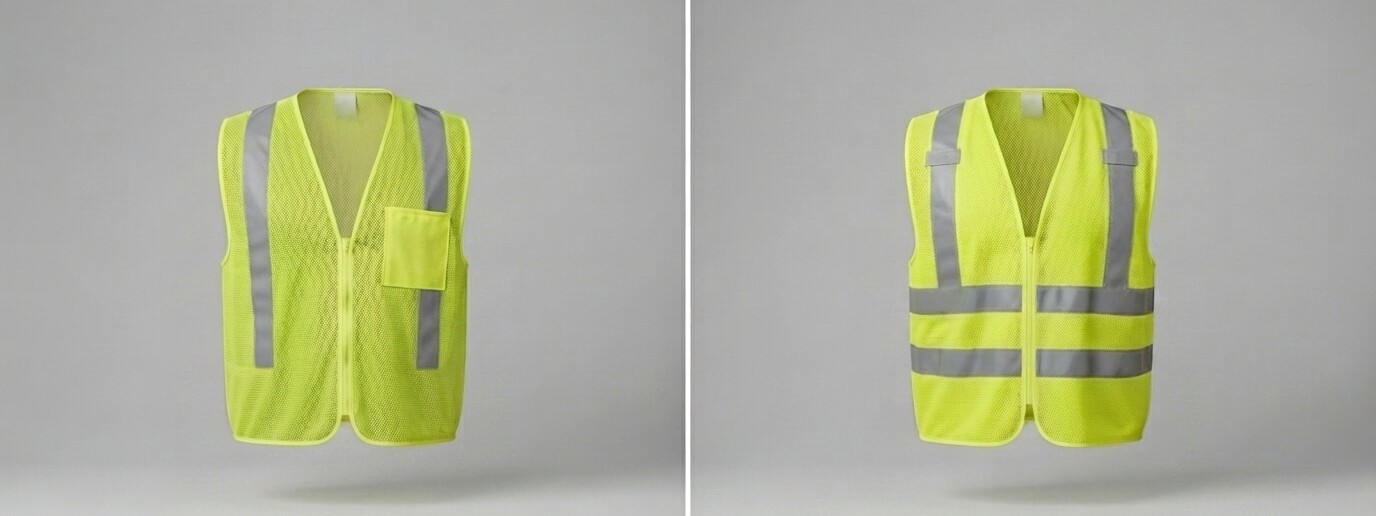
If you’ve been comparing safety vests and noticed the reflective tape is described as “Class 1” or “Class 2,” you’re looking at one of the most misunderstood parts of Australian hi-vis compliance. It’s not a vest size, a garment class, or a brand feature it’s a rating for the retroreflective tape itself, and it directly affects how visible you are in the dark.
This guide breaks down what Class 1 and Class 2 actually mean under AS/NZS 1906.4, how they differ in real-world performance, and most importantly how to work out which class your role actually needs.
What Retroreflective Classes Mean Under AS/NZS 1906.4
Two separate Australian standards govern hi-vis vests, and it’s easy to conflate them.
- AS/NZS 4602.1 governs the garment itself fluorescent fabric area, tape placement, and the overall vest classification (D, D/N, or R).
- AS/NZS 1906.4 governs the retroreflective material the reflective tape sewn or heat-sealed onto the vest and sets performance classes for how effectively that tape reflects light back to its source.
AS/NZS 1906.4 defines retroreflective material by how much light it bounces back under standardised test conditions, measured in candela per lux per square metre (cd/lx/m²). The higher the number, the more visible the tape is to a driver’s headlights at night or in low light. Class 1 and Class 2 sit at different points on that performance scale, and a vest’s overall night-time visibility depends heavily on which class of tape it’s built with. For a full breakdown of how the classing system works, see our guide to understanding retroreflective material classes.
Class 1 Explained: Performance Specs & Typical Uses
Class 1 retroreflective material is the baseline performance tier under AS/NZS 1906.4. It still meets the minimum retroreflectivity required for daytime and general low-light visibility, but it reflects noticeably less light back to a light source than Class 2 material.
Typical characteristics of Class 1 tape:
- Meets minimum retroreflectivity thresholds for general workwear
- Commonly used on Class D (day-only) vests, where night-time retroreflective performance isn’t the primary requirement
- More affordable to manufacture, which keeps entry-level vest pricing lower
- Adequate for indoor environments, daytime outdoor work, and settings with good ambient lighting
Class 1 is not a lesser or non-compliant option it’s simply matched to roles where full night-time high-speed visibility isn’t the main risk being managed. A day-shift warehouse worker or a daytime landscaping crew is a typical fit for Class 1 tape.
Class 2 Explained: Higher Performance & When It’s Required
Class 2 retroreflective material sits at the top of the performance scale under AS/NZS 1906.4. It reflects significantly more light back toward its source than Class 1, which translates directly into better visibility at night, in low-light conditions, or when a worker needs to be seen from a greater distance — such as by a driver approaching at speed.
Typical characteristics of Class 2 tape:
- Higher candela per lux per square metre rating than Class 1
- Required for Class D/N (day/night) and Class R (road/rail) vests, where after-dark visibility is essential
- Standard for roadside work, traffic control, emergency response, and any role near moving vehicles after dark
- More expensive than Class 1 tape, reflected in the price of D/N and R-class vests
If your role involves working near traffic, in low-light conditions, or during night shifts, Class 2 tape isn’t optional it’s the minimum performance level the standard expects for that level of risk.
Visual Comparison: Retroreflectivity at Night
The easiest way to understand the difference is to picture two workers standing roadside at night, both lit by the same set of headlights from 100 metres away.
| Factor | Class 1 | Class 2 |
| Relative brightness under headlights | Visible, moderate reflection | Noticeably brighter, sharper reflection |
| Typical use case | Daytime work, indoor/general settings | Night work, roadside, low-light |
| Vest classes it supports | D (Day only) | D/N and R |
| Driver recognition distance | Shorter | Longer |
| Cost | Lower | Higher |
In practice, a worker in Class 1 tape at night can still be seen, but a worker in Class 2 tape is identifiable from further away and stands out more sharply against headlights and streetlighting which is precisely why the standard mandates Class 2 for any role where being seen after dark is a genuine safety-critical requirement.
Which Class Does Each Safety Vest Class (D, D/N, R) Require?
This is where the two standards intersect, and it’s the part most people actually need to know before buying.
| Vest class (AS/NZS 4602.1) | Description | Retroreflective tape required (AS/NZS 1906.4) |
| Class D | Day use only | Class 1 (minimum) |
| Class D/N | Day and night use | Class 2 |
| Class R | Road and rail workers, day and night | Class 2 |
If you’re unsure which garment class your role actually requires, our detailed guide on retroreflective tape requirements under AS/NZS 4602.1 walks through tape placement, minimum area, and how it interacts with the garment class system.
⚠️ Important Wearing a Class D vest (Class 1 tape) for night-time roadside work does not meet the intent of the standard, even if the vest is otherwise compliant for daytime use. If your job takes you near traffic after dark, at dawn, or at dusk, you need a D/N or R class vest with Class 2 tape not a Class D vest with Class 1 tape.
How to Read the Compliance Label on Your Vest
Every compliant safety vest should carry a label referencing both standards and the specific classes it meets. When checking a vest, look for:
- The AS/NZS 4602.1 reference, confirming the garment class — D, D/N, or R.
- The AS/NZS 1906.4 reference, confirming the retroreflective material class — 1 or 2.
- A batch or manufacturer code, which allows the material to be traced if a compliance question arises.
If a vest’s label only references one of the two standards, or doesn’t specify a tape class at all, treat that as a red flag. A garment can technically use compliant fluorescent fabric while pairing it with reflective tape that doesn’t meet the class the role actually requires — the label is the only reliable way to confirm both halves of the compliance picture at once.
Microprismatic vs Glass Bead Within Each Class
Within both Class 1 and Class 2, retroreflective tape is manufactured using one of two underlying technologies, and this affects durability and performance as much as the class rating does.
Glass bead tape works by embedding millions of tiny glass beads in the tape surface, each acting as a tiny reflector. It’s the more traditional and generally more affordable technology, and it performs well across a wide range of viewing angles, though performance can degrade faster with repeated washing and abrasion.
Microprismatic tape uses a moulded prism structure instead of beads, reflecting light back more efficiently and consistently. It typically holds up better over repeated laundering and general wear, making it a common choice for tape that needs to maintain Class 2 performance over a longer working life.
Both technologies can be manufactured to meet either Class 1 or Class 2 performance the class rating tells you how much light is reflected, while the bead-vs-microprismatic choice affects how consistently that performance holds up over time and washing cycles. Our full comparison of microprismatic vs glass bead reflective tape goes into the durability differences in more detail if longevity is a factor in your decision.
FAQs
What is the difference between Class 1 and Class 2 retroreflective tape?
Class 2 tape reflects significantly more light back to its source than Class 1, making it far more visible at night or in low-light conditions. Class 1 meets minimum daytime visibility requirements but isn’t rated for the same level of night-time performance.
What does AS/NZS 1906.4 Class 1 and Class 2 mean?
AS/NZS 1906.4 is the Australian standard that rates retroreflective materials by performance. Class 1 is the baseline tier suited to daytime and general visibility needs; Class 2 is the higher-performance tier required for night-time, roadside, and low-light work.
Which reflective class do I need for my job?
If your role is daytime-only and away from moving traffic, Class 1 tape (on a Class D vest) is generally sufficient. If you work at night, at dawn or dusk, or near vehicles at any time, you need Class 2 tape on a Class D/N or Class R vest.
Does Class 2 reflective tape cost more?
Yes, Class 2 tape is more expensive to manufacture and typically adds to the overall cost of a D/N or R class vest compared to an equivalent Class D vest with Class 1 tape. The added cost reflects the higher retroreflective performance required for night and roadside visibility.
Can a Class D vest be upgraded with Class 2 tape?
Not straightforwardly. A vest’s classification depends on the combination of fluorescent fabric area, tape placement, and tape class as originally certified. Simply adding higher-grade tape to an existing Class D vest doesn’t automatically requalify it as D/N the correct approach is to purchase a vest manufactured and certified to the D/N or R standard from the outset.
The Takeaway
Class 1 and Class 2 retroreflective tape aren’t interchangeable they’re matched to genuinely different risk levels. Class 1 covers daytime and general visibility needs on Class D vests; Class 2 is the higher-performance tier required whenever night-time or roadside visibility is safety-critical, on Class D/N and Class R vests. Before ordering vests for your team, confirm not just the fluorescent colour and garment class, but the retroreflective tape class printed on the compliance label — it’s the detail most likely to be overlooked, and the one that matters most after dark.