






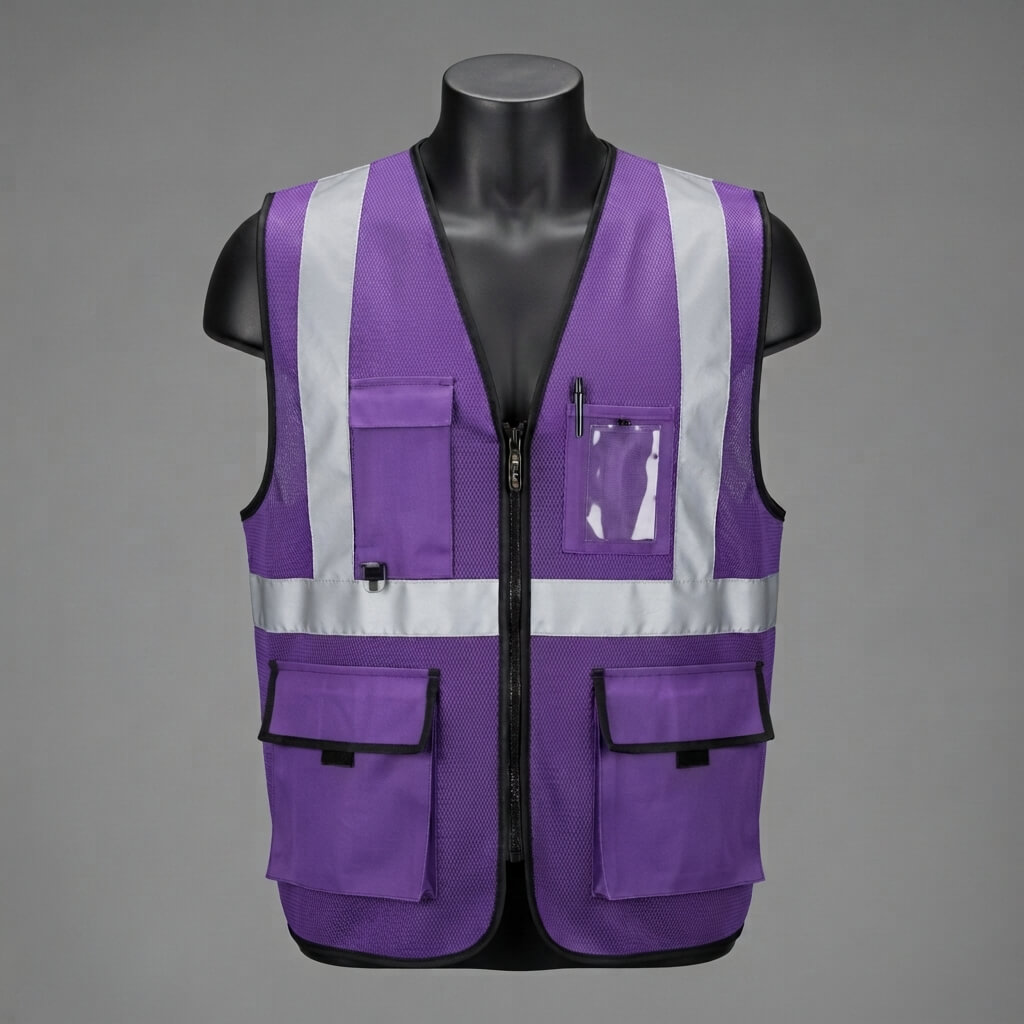
If you’ve searched for a purple hi vis vest, chances are you’re either trying to identify a specific role on-site a supervisor, a spotter, a visito or you’ve simply seen one worn on a mine site or construction project and wondered where it fits into Australian PPE rules.
Here’s the short version: purple is not one of the approved fluorescent colours under AS/NZS 4602.1, so a purple vest on its own is not a compliant hi-vis garment in the way a yellow-green or orange-red vest is. That doesn’t mean purple vests don’t exist or aren’t useful it means they’re doing a different job. This guide explains exactly what that job is, where purple fits alongside other role-identifier colours, and what to check before you buy one.
Why Purple Hi-Vis Vests Exist
On a large site a mine, a major construction project, an event, a warehouse dozens of people can be wearing standard fluorescent vests at once. When everyone is in yellow-green, it becomes hard to tell at a glance who’s a general worker, who’s a supervisor, who’s authorised to be in a restricted zone, or who’s a first-time visitor.
This is where role-identification colours come in. Sites will often layer a second, non-standard colour on top of (or instead of) the standard fluorescent base, purely so that specific roles are visually distinguishable from a distance. Purple has become a common choice for this because it’s visually distinct from the yellow-green and orange-red used for general PPE, and it doesn’t get confused with the reds, blues, and whites used for other designations.
In other words, a purple vest usually isn’t trying to be the safety vest it’s trying to say “this person is something specific” while a compliant hi-vis garment is doing the actual visibility work underneath or alongside it.
Is Purple a Compliant AS/NZS 4602.1 Colour?
No. AS/NZS 4602.1 recognises only three fluorescent colours for high-visibility garments:
- Fluorescent yellow-green
- Fluorescent orange-red
- Fluorescent red (used less commonly)
Purple, along with colours like pink, blue, and white, sits outside this list. A garment doesn’t become “hi-vis” under the standard just because it’s bright or eye-catching — it has to meet specific luminance and colorimetric requirements that only those three fluorescent colours satisfy. Purple fabric, however saturated, doesn’t meet the daylight luminance factor the standard requires.
⚠️ Important A vest that is entirely purple, with no compliant fluorescent base colour and no retroreflective tape meeting the standard’s placement rules, cannot be relied on as a worker’s primary high-visibility PPE. If a role on your site legally requires hi-vis (which most construction, roadwork, and many mining roles do), that requirement still has to be met by a compliant yellow-green or orange-red garment purple can only ever be an addition to that, not a replacement for it.
This is the same underlying issue covered in our guide on pink safety vests and whether they’re compliant non-standard colours can be worn, but they don’t satisfy a legal hi-vis requirement by themselves.
Industries That Use Purple Vests
Despite not being a compliant colour, purple shows up fairly consistently in a few specific contexts:
Mining and resources. Large mine sites often run detailed colour-coded systems to identify roles at a distance trainees, spotters, supervisors, visitors, contractors, and emergency response personnel may each be assigned a different vest colour. Purple is frequently used for one of these designations, particularly for site management, training staff, or specific authorisation levels, precisely because it’s uncommon and easy to spot in a sea of yellow-green.
Site supervision and management. On construction and civil sites, a supervisor or site manager will sometimes wear a purple vest (often over or alongside a compliant base layer) so workers and subcontractors can identify who to report to without needing to check an ID badge.
Events and traffic management. Purple is occasionally used at large public events to mark out specific crew functions medical liaison, event control, or accreditation staff — separate from general security or traffic control roles.
Visitor and contractor identification. Some sites issue purple vests specifically to visitors, so anyone unfamiliar with the site’s layout or procedures is immediately identifiable to permanent staff.
The common thread across all of these: purple is being used as a role marker, not as the site’s compliant PPE layer.
Purple vs Other Role-Identifier Colours
Purple isn’t the only non-standard colour used this way. Understanding where it sits relative to the others helps clarify what it’s actually communicating.
| Colour | Common role association | Compliant under AS/NZS 4602.1? |
| Purple | Site management, mining role ID, training staff | No |
| White | Traffic control, first aid, occasionally management | No |
| Blue | Electrical/trades identification, some contractor roles | No |
| Fluorescent yellow-green | General workers, day-class PPE | Yes |
| Fluorescent orange-red | General workers, alternative day-class PPE | Yes |
| Combination (yellow-green base + coloured trim) | Role ID over compliant base | Base colour is compliant |
As the table shows, blue safety vests sit in the same category as purple useful for identification, not for meeting a hi-vis requirement on their own. The safest and most common approach on sites that need both compliance and role differentiation is a compliant fluorescent base vest with purple trim, piping, or printed text, rather than a fully purple garment.
For a broader breakdown of which colours are and aren’t approved, see our full hi-vis colours guide for Australia.
What to Look For If You Still Need Purple
If your site has a genuine reason to use purple role identification, visitor marking, an internal colour-coding system there are two ways to do it properly:
- Purple trim or panels on a compliant base vest. This is the most common and safest option. The vest’s main body and reflective tape still meet AS/NZS 4602.1 in fluorescent yellow-green or orange-red, with purple used as an accent, a strip, or printed branding. This keeps the vest legally usable as hi-vis PPE while still achieving the visual role differentiation you’re after.
- A fully purple garment worn as a secondary layer. In this setup, the purple vest, sash, or armband is worn over or alongside a separately compliant hi-vis garment — not instead of it. This is common for visitor sashes or supervisor overlays where the underlying worker is already correctly kitted out.
What doesn’t work: relying on a solid purple vest, with no compliant fluorescent colour and no correctly placed retroreflective tape, as a worker’s only PPE on a site where hi-vis is mandated. That leaves both the worker and the business exposed to the same non-compliance and WHS liability issues that apply to any non-compliant vest.
Custom Printing Purple Onto a Compliant Base Vest
For most sites, the practical answer is custom printing: start with a fully AS/NZS 4602.1 compliant vest in fluorescent yellow-green or orange-red, then add purple through printed logos, role text (“SUPERVISOR”, “VISITOR”, “TRAINEE”), piping, or branded panels.
This approach gives you:
- Full compliance — the base garment still meets fluorescent area and retroreflective tape requirements.
- Clear role visibility — purple printing or trim is still highly distinguishable at a distance, especially against a yellow-green or orange-red base.
- Consistency across a team — every size in your team can carry the same purple branding without needing a separate non-standard product line.
🔍 Bottom line If you need purple for identification purposes, the smart move is compliant base + purple customisation, not a solid purple vest. It solves the visibility problem you’re actually trying to solve, without creating a compliance problem you didn’t have before.
→ Want a custom purple design on a fully compliant hi-vis vest? View our custom printing options and we’ll help you get the base garment, colour, and branding right in one order.
Frequently Asked Questions
Is purple hi-vis compliant in Australia?
No. AS/NZS 4602.1 only recognises fluorescent yellow-green, fluorescent orange-red, and fluorescent red as compliant hi-vis colours. A purple vest doesn’t meet the luminance requirements the standard sets, so it can’t be used as a worker’s sole high-visibility PPE.
What industry uses purple safety vests?
Purple is most commonly seen in mining and resources for role and access-level identification, as well as for site supervisors, event crew, and visitor identification on larger construction and industrial sites. It’s used to distinguish roles, not to meet a hi-vis requirement.
Can I buy a purple hi-vis vest in Australia?
Yes, purple vests and purple-trimmed vests are available, but check the product specifications carefully. If the listing doesn’t reference AS/NZS 4602.1 compliance or doesn’t specify a compliant fluorescent base colour, assume it’s a role-identification garment only, not certified PPE.
What’s the difference between a purple vest and a compliant hi-vis vest?
A compliant vest is made from fluorescent yellow-green or orange-red fabric with retroreflective tape placed and sized to the standard. A purple vest, unless it’s built on top of that same compliant base, is a visibility and identification tool but doesn’t carry the same certified protection.
Can I get a compliant vest with purple branding?
Yes — this is the recommended approach. A compliant yellow-green or orange-red vest with purple printing, piping, or panels gives you both the legal PPE requirement and the visual role distinction in one garment. See our custom printing page for options.
The Takeaway
Purple hi-vis vests aren’t a compliance product they’re a role-identification tool, and a genuinely useful one on larger or more complex sites. The mistake to avoid is treating a solid purple vest as equivalent to certified PPE. If your team needs both compliance and purple identification, the answer is a compliant fluorescent base vest with purple added through trim, panels, or printing not a fully purple garment worn on its own.