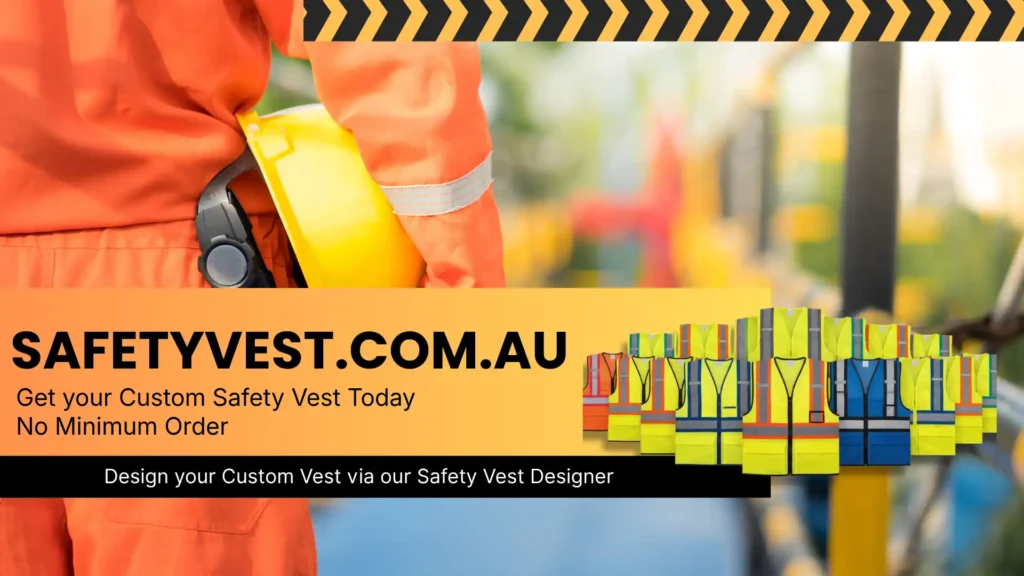
Imagine a cherry‑picker perched 12 metres above a bustling construction site, the midday sun reflecting off the steel girders. A forklift rumbling past, a crew member on a ladder below—suddenly a gust of wind lifts a loose piece of debris. In that split second the operator’s visibility can be the difference between a close call and a serious injury.
In the next few minutes you’ll discover exactly what hi‑vis clothing every cherry‑picker operator must wear to stay compliant and safe. We’ll unpack the relevant Australian standards, walk through a step‑by‑step checklist for selecting the right vest, expose the most common field‑level mistakes, and show how the right garment fits into construction, mining, and event‑site workflows. By the end you’ll know how to keep your crew visible, avoid costly penalties, and order custom‑printed vests with no minimum order hassle.
Contents
- What the hi‑vis requirement is and why it matters
- Choosing the right vest: step‑by‑step guide
- Compliance with Australian standards and enforcement bodies
- Common mistakes and misconceptions on worksites
- Industry‑specific context for construction, mining, and events
- Frequently Asked Questions
- Key take‑aways and next steps
What the hi‑vis requirement is and why it matters
Featured snippet: Cherry‑picker operators in Australia must wear a Class R or Class D/N high‑visibility vest that meets AS/NZS 4602.1:2011, includes at least 50 mm of retro‑reflective tape encircling the torso, and uses the approved fluorescent yellow‑green or orange‑red base colour. The vest must be worn whenever the operator is on a raised platform, in daylight or at night, and must be maintained in good condition.
Why does this matter? Cherry‑picker work is high‑risk by definition—operators are elevated, often near moving plant, and exposed to changing light conditions. A bright, fully reflective vest makes the operator stand out against steel, concrete, and sky, giving nearby traffic controllers, crane drivers, and fellow tradespeople a clear visual cue. Moreover, the law backs it up: SafeWork NSW and other state WHS bodies can levy fines up to $1.5 million for non‑compliant hi‑vis attire that contributes to an incident.
The short answer is simple—choose the correct class, colour, and tape width, and you’ll meet the legal threshold while dramatically improving on‑site safety.
Choosing the right vest: step‑by‑step guide
Below is a practical checklist you can run through before the next lift. Follow the steps in order, and you’ll end up with a vest that ticks every box on the compliance checklist and the site‑specific demands of cherry‑picker work.
| Step | What to check | Why it matters |
|---|---|---|
| 1. Determine the vest class | Class R (road‑work/high‑risk) or Class D/N (day + night) | Class R is mandatory when work is near live traffic or in high‑risk zones; Class D/N suffices for general construction where night work occurs. |
| 2. Confirm base colour | Fluorescent yellow‑green or fluorescent orange‑red | Only these two hues are approved under AS/NZS 4602.1; they provide the highest luminous intensity in daylight. |
| 3. Verify retro‑reflective tape | Minimum 50 mm width, continuous around the torso, meets AS/NZS 1906.4 | Tape of this width ensures the vest is detectable from ≥200 m at night when illuminated by vehicle headlights. |
| 4. Check garment size and fit | XS‑7XL, snug but not restricting movement; sleeves long enough to stay on when reaching up | A properly fitted vest stays in place on a moving platform, avoiding gaps that could reduce visibility. |
| 5. Choose fabric type | Classic zip‑front (Class D/N) or mesh (breathable for hot days) | Mesh vests keep the operator cool in the Australian summer while still delivering required retro‑reflectivity. |
| 6. Decide on customisation | Screen print, embroidery, heat transfer – upload AI, EPS, PNG, etc. | Branding helps identify crews and satisfies client‑specific safety programmes without extra setup fees. |
| 7. Confirm order logistics | No minimum order, 5‑7 business day standard delivery, tracked shipping nationwide | Fast, cost‑effective supply means you can replace damaged vests without delay. |
How to use the checklist on site
- Pre‑task briefing – Hand out the checklist to the site supervisor and ask them to verify each item before work begins.
- Vest inspection – While the operator is getting into the cherry picker, confirm the vest is clean, tape isn’t peeled, and the fit is secure.
- Documentation – Record the vest’s class and size in the daily safety register; this satisfies SafeWork NSW audit requirements.
By turning this simple table into a routine part of your lift‑plan, you embed compliance into everyday practice rather than treating it as an after‑thought.
Compliance with Australian standards and enforcement bodies
The legal backbone for hi‑vis garments is AS/NZS 4602.1:2011 – High Visibility Safety Garments. This standard sets out the colour, reflectivity, and construction rules that all Class R, D, and D/N vests must meet. For cherry‑picker operators, the key clauses are:
- Colour requirement – Only fluorescent yellow‑green (Munsell 13GY 14/5) or fluorescent orange‑red (Munsell 7.5R 14/5) are acceptable.
- Retro‑reflective tape – Minimum 50 mm width, full‑torso coverage, performance class 2 (≥550 cd·lux⁻¹).
- Garment durability – Must retain colour and reflectivity after at least 100 wash cycles.
If the work involves an electrical hazard, the vest may also need to satisfy AS/NZS 1906.4 for static‑dissipative properties, though this is less common for cherry pickers.
Enforcement falls to each state’s WHS regulator—SafeWork NSW, WorkSafe Victoria, WHS Queensland, SafeWork SA, etc. Inspectors routinely check that workers on elevated platforms are wearing the correct class and that the vest is in good condition. Non‑compliance can trigger an improvement notice, and if the lapse contributes to an incident, a Category 2 penalty (up to $1.5 million for a body corporate in NSW) can be applied.
For a full breakdown of the standards, visit our Compliance Guide. When you order, you can also select the exact AS/NZS class via our live vest designer on the Custom Safety Vests page, ensuring the product you receive is audit‑ready straight out of the box.
Common mistakes and misconceptions on worksites
Even seasoned site managers get the hi‑vis basics wrong. Below are the top three field‑level blunders that put cherry‑picker operators at risk.
1. Using the wrong colour because “it looks nicer”
A supervisor might pick a bright neon pink or lime green thinking “more colour = more visibility”. The law doesn’t recognise those shades, and a 2024 inspection by SafeWork NSW flagged 27 % of non‑conforming vests for colour misuse. The result? A stop‑work order until compliant vests are supplied.
2. Treating a Class D vest as sufficient for high‑risk lifts
Class D offers day‑time visibility only—no reflective tape. When work extends past dusk or the site is near traffic, operators must step up to Class R or D/N. A common myth on remote worksites is that “the platform is isolated, so we don’t need reflective tape”. The short answer is that isolation is rarely absolute; a passing truck or crane swing can still create a hazard.
3. Ignoring wear and tear on the retro‑reflective tape
Retro‑reflective tape degrades with UV exposure, especially in the Australian outback. Many sites stretch a vest over a tool belt or pull it over a hard hat, peeling the tape at the seams. After a few weeks the vest no longer meets the 550 cd·lux⁻¹ threshold. A quick visual test—shine a car headlamp at the vest from 15 metres—will reveal any loss of shine. Replace any faded vests immediately; the cost of a new vest is far less than a potential fine.
Bonus tip
Don’t let “no‑minimum‑order” policies tempt you into a one‑off purchase only to discover the sizing chart is wrong. Our online designer lets you preview the vest on a virtual mannequin, so you can verify that the chosen size (XS‑7XL available) truly fits the operator before the fabric is cut.
Industry‑specific context
Cherry‑picker work isn’t confined to one sector. Here’s how the hi‑vis requirement plays out across the three main industries we serve.
Construction & Building
A high‑rise project in Sydney’s CBD uses cherry pickers for façade cleaning. With hundreds of pedestrians below, the operator must wear a Class R vest in fluorescent orange‑red, featuring high‑visibility tape that wraps fully around the torso. Our Classic Zip‑Front Hi‑Vis Vest – Class R fits the bill, and can be embroidered with the contractor’s logo at no extra set‑up cost. The vest’s zip‑front design allows quick removal in an emergency egress.
Mining & Resources
In a Queensland open‑cut mine, cherry pickers are used for equipment inspections on steep slopes. The environment is dusty and hot, so a Mesh Hi‑Vis Vest with breathable open‑weave keeps the operator cool while still meeting Class D/N standards for night‑time visibility. Because the mine’s safety plan mandates arc‑rating for fire‑risk zones, operators sometimes opt for our Flame‑Resistant (FR) Vest that also satisfies AS 2980, providing an extra layer of protection without compromising visibility.
Events & Crowd Control
A major music festival in Perth uses cherry pickers to adjust lighting rigs. The venue is lit with coloured stage lights, which can wash out certain hi‑vis hues. For this scenario a Class D/N vest in fluorescent yellow‑green provides the best contrast against both dark crowds and bright stage illumination. The vest can be printed with the event’s branding via heat transfer, reinforcing both safety and marketing in one garment.
Across all these settings, the ability to order single‑vest quantities and receive tracked delivery within 5–7 business days means you can replace damaged or lost vests without disrupting the schedule. Volume discounts kick in at 25 units, making it economical for larger crews.
Frequently Asked Questions
Q: Do cherry‑picker operators need a Class R vest even if they’re working inside a building?
A: Inside a building, a Class D/N vest is usually sufficient unless the work is near moving plant or live traffic. If the operator may be exposed to vehicular movement (e.g., delivery trucks in a loading dock), a Class R vest is the safer, compliant choice.
Q: Can I use a standard high‑vis shirt instead of a vest?
A: No. The AS/NZS 4602.1 standard requires a full‑torso vest with the minimum 50 mm retro‑reflective band. Shirts, even with reflective strips, do not meet the size or placement criteria for elevated‑platform work.
Q: How often should the retro‑reflective tape be inspected?
A: Conduct a visual inspection before each shift. Look for peeling, cracking, or loss of shine. A quick headlamp test from 15 metres will reveal any reduction in reflectivity. Replace the vest at the first sign of degradation.
Q: Are there special requirements for night‑time cherry‑picker work?
A: Yes. Night work mandates Class D/N or Class R vest with reflective tape. The vest must cover the entire torso and be free from obstructions (e.g., over‑large tool belts that hide the tape). Adding a reflective neck band can improve visibility of the head and neck area.
Q: What logo formats can I submit for custom printing?
A: We accept AI, EPS, PDF, PNG and SVG files. Upload your artwork directly through the live designer on our Custom Safety Vests page—there are no set‑up or artwork charges, regardless of order size.
Key take‑aways and next steps
- Select the correct class and colour – For cherry‑picker operators, Class R or Class D/N in fluorescent yellow‑green or orange‑red is mandatory.
- Check tape width and condition – 50 mm continuous retro‑reflective tape that passes a headlamp test is non‑negotiable.
- Fit, fabric and customisation matter – Choose the right size (XS‑7XL), breathable mesh for hot days, and add branding through our free‑artwork service.
Staying compliant isn’t just about avoiding a fine; it’s about keeping the people who work at height visible, protected, and able to get the job done safely. If you’re ready to order a compliant vest—or need a quick replacement—reach out via our Contact Us page or explore the full range on the Products catalogue. Safety starts with what you wear; make sure it’s the right hi‑vis vest for every cherry‑picker lift.