
Every worker on an Australian worksite that involves vehicle movement, plant equipment or reduced visibility conditions is required by law to wear a compliant high-visibility safety garment. Selecting a non-compliant vest — or wearing a compliant vest incorrectly — can result in workplace injury, WorkSafe or SafeWork improvement notices, and significant liability for employers.
This guide explains everything you need to know about safety vest compliance in Australia: the standards that govern high-visibility garments, the difference between vest classes, which class applies to which industry, what the reflective tape requirements are, and how to verify a vest’s compliance before purchasing.
AS/NZS 4602.1:2011 — formally titled High Visibility Safety Garments, Part 1: Garments for High Visibility Wear — is the joint Australian and New Zealand standard that defines the minimum requirements for high-visibility safety garments worn on worksites across both countries. It is published jointly by Standards Australia and Standards New Zealand, and was last revised in 2011.
The standard covers fabric colour luminance, retroreflective tape width, tape placement configuration, garment construction and labelling requirements. A safety vest that does not comply with AS/NZS 4602.1 cannot legally be used as personal protective equipment (PPE) on Australian worksites where high-visibility garments are mandated.
Compliance with AS/NZS 4602.1 is mandated under the Model Work Health and Safety (WHS) Regulations adopted across most Australian states and territories, including SafeWork NSW, WorkSafe Victoria, Workplace Health and Safety Queensland, and equivalent authorities in South Australia, Western Australia, Tasmania, the ACT and the Northern Territory.
The standard is separate from the workplace safety law itself — it is a product standard, not a regulation. However, Australian WHS regulations require that PPE selected by an employer must meet the relevant Australian standard. Purchasing vests from an unverified supplier without confirming AS/NZS 4602.1 compliance exposes both the employer and the worker to unacceptable risk.
AS/NZS 1906.4 — Retroreflective Materials and Devices for Road Traffic Control Purposes, Part 4: High Visibility Materials for Safety Garments — is the companion standard that governs the performance of the retroreflective tape used on high-visibility safety vests.
Whereas AS/NZS 4602.1 specifies how tape must be placed on a garment (width, configuration, coverage area), AS/NZS 1906.4 specifies the optical performance that the tape material itself must achieve. This includes minimum retroreflectivity values (measured as coefficient of retroreflection in candela per lux per square metre) at defined observation and entrance angles.
In practical terms: a vest can have tape in all the right positions and still fail to comply if the tape material itself does not meet the retroreflectivity requirements of AS/NZS 1906.4. This is why purchasing from verified suppliers matters — a non-compliant tape may look identical to a compliant tape under normal lighting, but will fail to adequately reflect vehicle headlights at night.
A vest that complies with AS/NZS 4602.1 but uses tape that does not meet AS/NZS 1906.4 is non-compliant. Always purchase from suppliers who can confirm compliance with both standards. All vests supplied by SafetyVest.com.au meet both AS/NZS 4602.1 and AS/NZS 1906.4.
AS/NZS 4602.1 defines three garment classes based on the level of visibility they provide and the conditions in which they must be worn. Selecting the wrong class for your worksite environment is a compliance failure — even if the vest itself carries a valid AS/NZS 4602.1 label.
Daytime Only
Warehousing, general construction, events, schools, landscaping, indoor logistics
Day & Low Light
Construction, surveying, engineering, site supervision, outdoor work across varied shift times
High Risk Mandatory
Traffic control, road maintenance, highway construction, rail corridors, mining operations, utilities near roads
Class R requires significantly greater retroreflective tape coverage than Class D/N. A standard zip-front vest with two horizontal tape bands is typically Class D/N — it does not automatically qualify as Class R. Traffic controllers, road maintenance workers and rail workers must wear Class R-rated garments that specifically state “Class R” on the compliance label.
AS/NZS 4602.1 approves two fluorescent background colours for compliant safety garments in Australia. Critically, the standard does not simply specify “yellow” or “orange” — it defines precise chromaticity coordinates and minimum luminance factor values that the fabric must achieve when tested. This means that many commercially available yellow or orange fabrics do not qualify as compliant hi-vis materials.
The most widely used compliant hi-vis colour in Australia. High contrast against natural backgrounds. Preferred on construction sites, warehouses and general worksites.
The approved orange tone for compliant hi-vis vests. High visibility against both natural and built environments. Common on mining sites, traffic control and construction.
Pale yellow, pastel orange, or faded hi-vis fabric that no longer meets the minimum luminance factor required by AS/NZS 4602.1 is non-compliant — even if it was once compliant when new. Faded vests must be replaced. Always purchase from verified suppliers who can confirm the fabric meets the standard’s chromaticity and luminance requirements.
The standard does not permit white, lime green, bright red or any other colour as the primary background fabric — regardless of how bright or visible these colours may appear to the human eye. Only fluorescent yellow-green and fluorescent orange-red meet the photometric requirements specified in AS/NZS 4602.1.
Retroreflective tape is the silver-grey banding found on Class D/N and Class R safety vests. It works by bouncing incoming light — most importantly, vehicle headlights — directly back toward its source, making the wearer visible to approaching drivers in low-light and night conditions.
AS/NZS 4602.1 specifies exact requirements for retroreflective tape on compliant garments. These are not suggestions — they are minimum mandatory requirements.
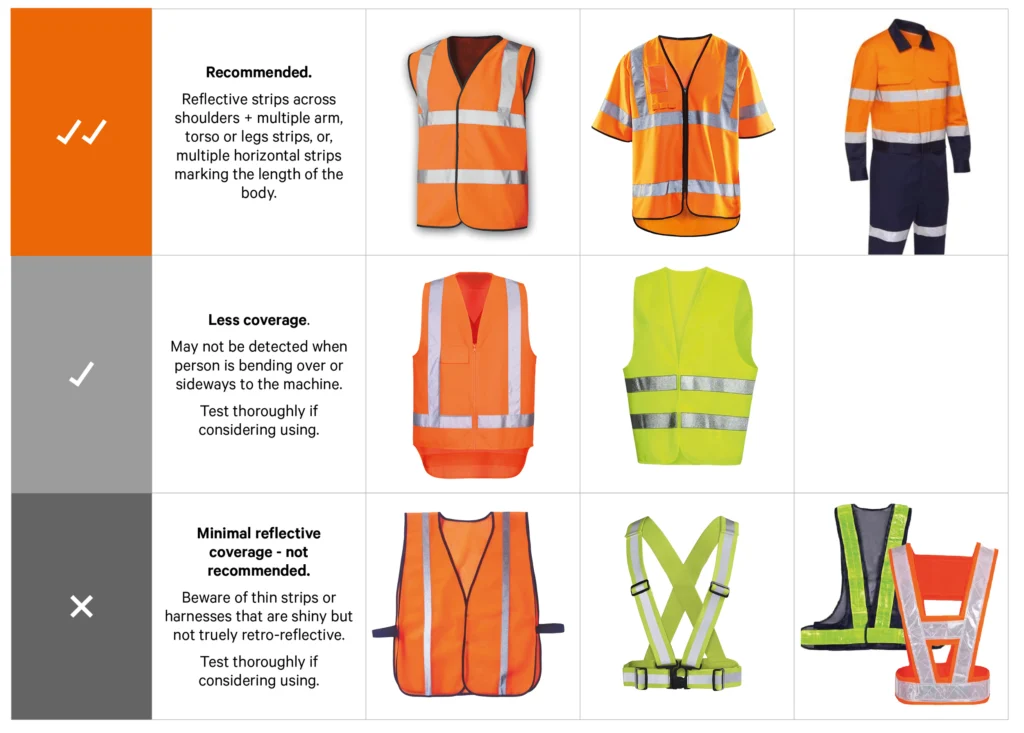
Class D/N minimum: two complete horizontal bands encircling the full torso. Bands that are interrupted or incomplete do not satisfy the requirement.
Class R minimum: significantly greater retroreflective tape area than Class D/N, including bands across the shoulders and additional torso coverage. Consult the standard or your supplier for specific measurement requirements.
Tape must encircle the full torso — meaning bands must wrap around the complete circumference of the garment, visible from every angle.
Tape must meet AS/NZS 1906.4 for optical retroreflective performance, not just AS/NZS 4602.1 placement requirements (see Section 2).
Tape must not be obscured in normal use by harnesses, tool belts, pockets, or other garments worn over the vest.
For workers in oil and gas, petrochemical processing, electrical utilities and any environment where ignition sources, open flames or arc flash risk are present, a standard hi-vis vest — even a Class R-rated one — does not provide adequate protection. These environments require flame-resistant (FR) safety vests.
FR safety vests in Australia must comply with AS/NZS 2980 (Quality of Welding, which covers arc-rated fabrics) and in some cases IEC 61482-2 for arc flash protection. They are also commonly required to be antistatic, meeting AS/NZS 1676.1, to prevent static discharge in explosive atmosphere environments such as fuel handling areas, grain silos and chemical plants.
Many workers assume that FR safety vests cannot be customised. This is incorrect. SafetyVest.com.au offers custom printing on FR-rated fabric using compliant methods that do not compromise the flame-resistant properties of the garment. Speak to our team about artwork options for hazardous environments.
When specifying FR vests for your workforce, you will need to know:
Arc rating (cal/cm²): The energy level the fabric can withstand before a worker is likely to receive a second-degree burn. Higher arc ratings indicate greater protection.
Fabric type: Common FR fabrics include Nomex, Protera, FR-treated cotton and inherent FR aramid blends. Each has different weight, comfort and durability characteristics.
Antistatic properties: Required in environments where static discharge could ignite flammable gases, vapours or dust.
Hi-vis compliance: The garment must still meet AS/NZS 4602.1 for visibility — FR protection alone is not sufficient if the worker also needs to be visible to vehicles or machinery.
The table below provides a practical reference guide for the minimum compliance class required across common Australian industries. Note that individual projects, principal contractors, mining companies and government contracts may specify requirements above the minimum — always check site-specific safety management plans.
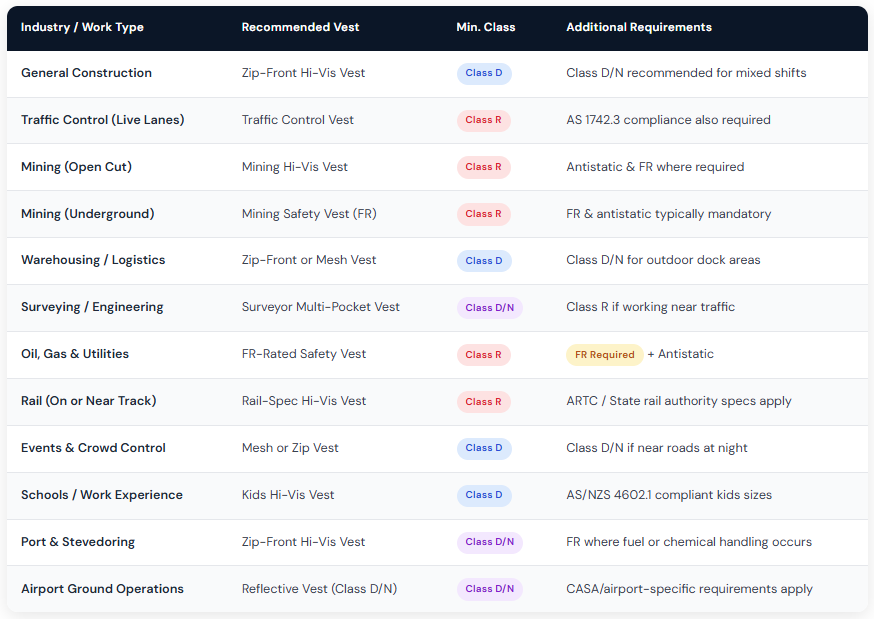
Major contractors (Tier 1 civil, mining companies) and government clients often specify requirements that exceed the minimum AS/NZS 4602.1 class. Always refer to the project’s Safety Management Plan (SMP) or site induction documentation before ordering. If in doubt, contact our team and we can advise on the right specification.
Not all vests sold in Australia as “hi-vis” or “safety vests” are genuinely compliant with AS/NZS 4602.1. Cheap imports, online marketplaces and unverified suppliers regularly sell non-compliant garments. Here is how to verify compliance before purchasing or allowing a vest on your site.
Check the Permanently Attached Compliance Label
Every AS/NZS 4602.1-compliant vest must carry a permanently attached label stating: the standard number (AS/NZS 4602.1), the class (D, D/N or R), the manufacturer’s name or identifier, the garment size, and care instructions. If any of these are missing, the vest is non-compliant.
Confirm Both Standards Are Referenced
The label or accompanying documentation should also reference AS/NZS 1906.4 to confirm the retroreflective tape material meets the optical performance standard. Confirm this with your supplier if it is not stated on the label.
Inspect the Retroreflective Tape
Measure the tape width — it must be at least 50mm. Check that it forms complete horizontal bands encircling the full torso. Confirm the tape is not cracked, separated, peeling or significantly discoloured, which indicates the material has degraded below the minimum reflectivity standard.
Check the Fabric Colour
The background fabric must be fluorescent yellow-green or fluorescent orange-red. Hold the vest next to a known compliant garment if in doubt — significant colour difference may indicate a non-compliant fabric. A vest that has faded over time may no longer meet the minimum luminance factor.
Request Supplier Compliance Documentation
For bulk orders and project-specification purchasing, ask your supplier for test certificates or third-party lab reports confirming the vest model meets AS/NZS 4602.1 and AS/NZS 1906.4. Reputable Australian suppliers maintain this documentation. SafetyVest.com.au can provide compliance documentation on request.
Match the Class to the Work Environment
Even a genuinely compliant vest is “non-compliant in use” if the wrong class is worn. A Class D vest worn by a traffic controller on a live traffic lane is a WHS violation — the vest itself may pass the standard, but the application does not meet the legal requirement. Always match the vest class to the hazard level.
A safety vest does not remain compliant indefinitely. Both the fluorescent fabric and the retroreflective tape degrade with use, washing and UV exposure. An employer has a legal obligation under WHS legislation to ensure PPE remains effective — which means a vest that no longer meets AS/NZS 4602.1 performance requirements must be retired, even if it is physically intact.
Retroreflective tape is cracked, peeling, separated or visibly degraded. Tape that has cracked or begun to separate from the fabric has lost significant retroreflective performance and will not adequately reflect vehicle headlights.
The fluorescent background fabric has noticeably faded. Faded fabric that appears dull, pale or washed-out no longer meets the minimum luminance factor required by AS/NZS 4602.1. Compare against a new vest of the same colour if in doubt.
Class R minimum: significantly greater retroreflective tape area than Class D/N, including bands across the shoulders and additional torso coverage. Consult the standard or your supplier for specific measurement requirements.
The vest has been torn, cut or significantly damaged. Physical damage to the garment compromises the integrity of tape bands and may reduce the total retroreflective area below the required minimum.
The compliance label is missing, illegible or detached. Without a permanently attached compliance label, the vest cannot be verified as compliant and should not be used on a regulated worksite.
The vest has been heavily soiled and cannot be adequately cleaned. Paint, concrete, mud or chemical contamination that permanently stains the fluorescent fabric reduces its luminance. Permanently soiled vests should be replaced.
The vest has exceeded its manufacturer’s recommended service life. Some manufacturers specify a maximum number of industrial wash cycles or a service life in years. Check care label instructions and manufacturer guidance.
Need to replace just two vests from a larger crew? No problem. SafetyVest.com.au has no minimum order — you can replace individual vests, match existing branding, and reorder from your file artwork on file. Call us on +61 477 123 699 or email sales@sandsindustries.com.au.
These are the most frequently observed safety vest compliance failures on Australian worksites — noted by SafeWork NSW, WorkSafe Victoria and other state regulators in their published inspection reports and safety bulletins.
Wearing a Class D vest on a traffic management site, or a Class D/N vest in a Class R environment. The most common compliance failure.
Fix: Match vest class to hazard level. Traffic control = Class R minimum.
Continuing to use vests with cracked tape or faded fabric past their compliant service life. Very common on long-running sites where vest replacement isn’t routinely reviewed.
Fix: Conduct quarterly vest inspections. Replace failed units immediately.
Wearing a full-body harness, tool belt or over-vest that covers or interrupts the retroreflective tape bands, rendering them ineffective.
Fix: Ensure tape is fully visible in worn configuration. Use over-vest with integrated tape if required.
Some workers wear vests inside-out to avoid getting them dirty. This places the fluorescent fabric and retroreflective tape on the inside, making the vest entirely non-compliant in use.
Fix: Provide enough vests per worker. Worn hi-vis on the outside, always.
Using industrial solvents, bleach or high-temperature washes that degrade both fluorescent fabric colour and retroreflective tape adhesion faster than normal service life.
Fix: Follow the care label instructions exactly. Cold wash, mild detergent, line dry where possible.
Buying cheap hi-vis vests from online marketplaces or discount stores without confirming AS/NZS 4602.1 compliance. Many such products carry a fake or inapplicable compliance label.
Fix: Always request compliance documentation. Buy from verified Australian suppliers.
Inspectors from SafeWork NSW, WorkSafe Victoria, WHS Queensland and other state authorities regularly issue Improvement Notices for non-compliant PPE on worksites. Continued non-compliance after notice can result in Prohibition Notices stopping work entirely. The maximum penalty for a WHS Category 2 offence in NSW is $1.5 million for a body corporate.
Every vest we supply at SafetyVest.com.au is manufactured to AS/NZS 4602.1 and AS/NZS 1906.4 standards. If you’re unsure which class or style is right for your worksite, call our team on +61 477 123 699 — we’re happy to advise.