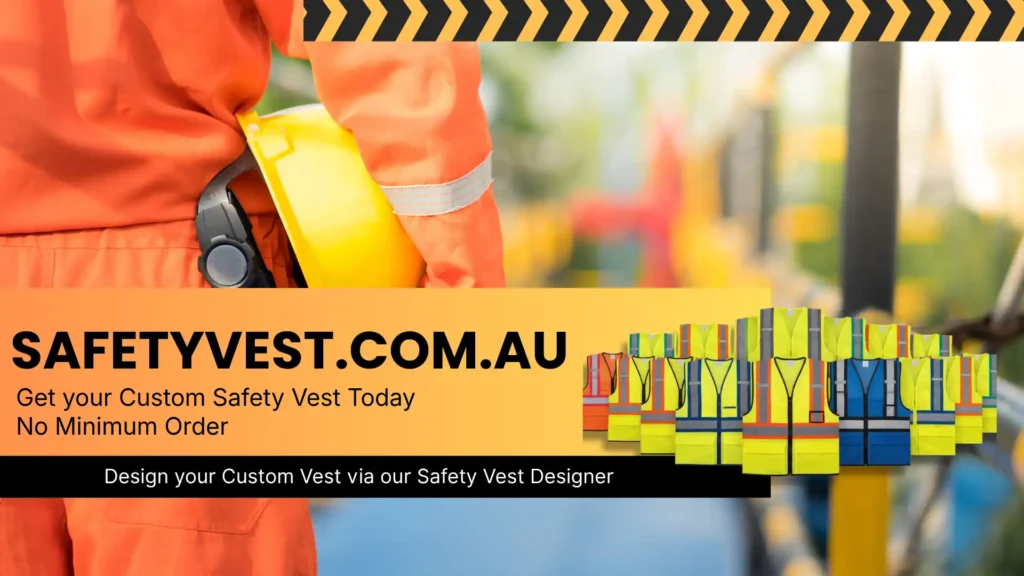
How Custom Safety Vests Improve Worksite Communication and Role Identification
A foreman on a bustling road‑work site in regional NSW reached for his radio, only to realise the traffic controllers were scattered across the lane—some in faded orange‑red vests, others in plain high‑vis without any colour coding. The result? A near‑miss with a delivery truck that could have turned into a serious injury, and an inevitable safety audit that flagged non‑compliant‑class vests. That split‑second confusion is a reminder that the right safety vest does more than meet AS/NZS 4602.1—it becomes a visual language that tells every worker, “I’m the supervisor, I’m the plant operator, I’m the pedestrian‑manager” before a word is spoken.
Why a Tailored Colour‑Code System Works
A custom safety vest lets you embed specific colour blocks, reflective strips and branding into a single garment. When a vest is designed for a particular role—say, Class R for roadwork supervisors, Class D for daytime labourers, or a dual‑class D/N for night‑shift plant operators—each worker instantly knows who they’re dealing with. On a live site, that instant visual cue cuts down radio chatter, reduces the need for hand signals, and minimises the risk of someone stepping into a hazardous zone.
Practical Tool: Role‑Identification Checklist
| ✅ Item | What to Verify on‑site | How it Helps Communication |
|---|---|---|
| Vest Class matches task | Class R for road‑work, Class D/N for night shift, Class D for day‑time labour | Guarantees legal compliance and ensures the right level of visibility |
| Colour band per role | Fluorescent orange‑red for traffic controllers, fluorescent yellow‑green for plant operators | Quick visual sorting; reduces mis‑placement |
| Reflective tape layout | Minimum 50 mm tape encircling torso, tape meets AS/NZS 1906.4 | Maintains visibility in low light, keeps everyone on the same visual wavelength |
| Branding placement | Company logo on left chest, role badge on right sleeve | Prevents confusion with contractors, clarifies authority |
| Vest condition | No fading, tears, or missing tape | Avoids missed signals that can lead to accidents |
Print this checklist and run it during daily toolbox talks; the habit alone can stop a lot of mis‑communication.
Where Sites Go Wrong
- Wrong vest class – A night‑shift electrician fitted with a day‑only Class D vest disappears once the sun sets.
- Faded hi‑vis – Cheap imports lose their fluorescence after a few washes, making the wearer blend into the background.
- Non‑compliant imports – Some overseas suppliers cut corners on the 50 mm reflective strip requirement, breaching AS/NZS 1906.4.
- Incorrect branding – Placing a logo over the reflective strip defeats its purpose and can attract fines from SafeWork NSW.
These errors not only invite penalties from WorkSafe Victoria or WHS Queensland but also erode the visual hierarchy that keeps crews coordinated.
Industry Examples
Construction
A Melbourne high‑rise project uses custom vests with a bold blue stripe for crane operators, a lime‑green block for scaffolders, and a bright orange panel for site managers. The colour blocks line up with the site‑specific traffic management plan, letting the site supervisor spot a stray worker before they step under a swinging load.
Traffic Control
In Queensland, a road‑work crew adopted dual‑class D/N vests with reflective “TC” badges on the right sleeve for traffic controllers and “ENG” badges for engineers. When a sudden rainstorm hit, the night‑visibility tape kept the controllers visible, while the badge instantly told a passing driver who was directing traffic.
Warehousing
A Sydney distribution centre printed bold “PICKER” and “FORKLIFT DRIVER” labels onto Class D vests. Forklift operators could be identified from across the bay, cutting down on near‑misses with pallet trucks that often occur in cramped aisles.
Mining
A Western Australian open‑cut mine uses custom Class R vests with high‑visibility orange‑red panels and a reflective “HEAVY‑MACH” patch for equipment attendants. The patch helps shift‑leaders spot the right person to shut down a haul truck during an emergency, slashing response time.
Events
During a large music festival in Adelaide, volunteers wore custom vests with colour‑coded sleeves: green for first‑aid, yellow for security, and red for crowd‑control. Festival staff could instantly direct attendees to the nearest help point without shouting over the crowd.
Compliance Quick‑Fix Guide
- Confirm the vest class – Match the task to Class D, N, D/N or R.
- Check reflective tape – Minimum 50 mm width, continuous around the torso, compliant with AS/NZS 1906.4.
- Verify colour – Only fluorescent yellow‑green or orange‑red are approved under AS 1742.3.
- Inspect condition – Replace any vest that looks faded or has torn seams.
- Document branding – Ensure logos and role identifiers do not interfere with reflective strips.
Running through these steps each month keeps your site audit‑ready and your crew visible.
Bottom Line
Custom safety vests turn a simple piece of clothing into a powerful communication tool. By aligning colour, class and branding with each role, you eliminate guesswork, speed up emergency response and stay squarely within Australian standards.
Got a site that needs a visual upgrade? Reach out to the experts at safetyvest.com.au and let the team design a vest system that talks the language of safety on your ground.
Take the next step: Request a free design quote today.
For more on how our manufacturing partner delivers compliant, Australian‑made garments, see Sands Industries.