Custom safety vests with your logo, no minimum orders. Safetyvest.com.au manufactures AS/NZS compliant hi-vis vests for every Australian industry. Fast delivery nationwide.
Trusted by Australian Businesses & Worksites | Fast Australia-Wide Shipping | Local NSW Support Team ABN: 30 629 811 383 | ACN: 629 811 383 📍 Unit 27/191 McCredie Road, Smithfield NSW 2164 📞 +61 4415 9165 | +61 477 123 699 🌐 safetyvest.com.au
Introduction: The Safety Vest Is the Most Important Garment on Any Australian Worksite
Think about the last time you drove past a road crew, walked through a construction site, or watched a forklift operator move through a warehouse. The first thing you noticed. The thing your brain registered before anything else was the bright yellow or orange flash of a high-visibility safety vest. That immediate visual recognition is not accidental. It is the result of decades of safety research, engineering standards, and hard lessons learned from serious workplace incidents across Australia and around the world.
The safety vest is, in many ways, the single most important garment in Australian workplace safety. It is the universal signal that says: I am here. See me. Don’t hit me. On a busy construction site at dusk, on a highway corridor in the rain, or in a warehouse where forklifts and pedestrians share the same floor that signal can be the difference between a worker going home at the end of their shift and a catastrophic incident that changes lives forever.
And yet, for all its importance, the safety vest market in Australia has long been poorly served. Too many businesses buy the cheapest possible vests, with no thought given to compliance, fit, reflective performance, or the specific demands of their worksite. Too many suppliers simply import offshore products, badge them, and resell without genuine quality oversight. And too many Australian workers spend eight, ten, or twelve hours a day in vests that are uncomfortable, non-compliant, ill-fitting, or simply not designed for the actual job they are doing.
Sands Industries, trading as safetyvest.com.au, exists to fix all of that.
We are Australia’s most comprehensive safety vest operation, a manufacturer, bulk supplier, custom branding partner, compliance resource, and ongoing supply partner, all operating from our base in Smithfield, New South Wales. This guide is the most detailed breakdown of what we offer, how we work, why compliance matters, and how to choose the right safety vest for every industry, role, and application across Australia.
Whether you are a sole trader ordering a handful of vests, a safety manager sourcing for a 1,000-person workforce, or a business owner wanting custom-branded high-visibility workwear that actually represents your brand, this is the guide you need.
Part One: What Actually Makes a Great Safety Vest Provider in Australia?
Before diving into product ranges and custom options, it is worth taking a step back and defining what separates a genuinely excellent safety vest provider from the dozens of generic workwear retailers that populate the Australian market.
1. Compliance Is Not Optional — It Is the Starting Point
In Australia, high-visibility safety garments worn on worksites that fall under state and territory Work Health and Safety (WHS) legislation must comply with AS/NZS 4602.1:2011 — the national standard for the design requirements of high-visibility safety garments. This is not a recommendation. On most regulated worksites, it is a legal requirement.
A safety vest that does not meet this standard is not a safety vest. It is a yellow shirt. And wearing it on a compliant worksite is a potential WHS violation for both the worker and the employer.
Genuine compliance means:
- The correct fluorescent background material — either yellow-green or orange-red — in the minimum required area
- The correct retroreflective tape configuration, meeting AS/NZS 1906.4 for retroreflective performance
- The correct class designation — Class D (day use), Class N (night use), or Class D/N (both) — for the specific work environment
- Correct garment construction — seam strength, care labelling, and marking requirements
Any provider that cannot clearly articulate these requirements and demonstrate how their products meet them is not a provider you should trust with your workforce’s safety.
2. Product Quality Must Be Consistent — Not Just for the Sample
One of the most common complaints businesses have about workwear suppliers is that the sample vest they approved was excellent, but the bulk production run was noticeably inferior. Stitching quality varies. Reflective tape adhesion varies. Fabric weight varies.
This is what happens when a supplier has no manufacturing oversight — they are entirely at the mercy of whoever produced the goods overseas, with limited ability to enforce quality standards.
3. Range and Specialisation Both Matter
A great provider needs both breadth — enough range to cover all your worksite roles in one order — and depth — genuine specialisation in specific product categories. A surveyor’s vest is not the same as a construction vest. A rail corridor vest is not the same as a warehouse vest. A female-fit vest is not a women’s XS in a unisex pattern.
4. Custom Capability That Goes Beyond a Logo Slap
True custom manufacturing is not iron-on a logo and call it branded workwear. It is colour-matching, reflective tape layout consideration, pocket engineering, closure selection, and sublimation printing technology — all executed while maintaining AS/NZS compliance.
5. Service and Supply Reliability
Safety vests wear out. Workforces grow. Contracts change. A provider that cannot reliably restock your exact spec at short notice is a provider that will eventually leave your team unequipped at the worst possible moment.
Sands Industries delivers on all five of these requirements. Let’s walk through exactly how.
Part Two: Sands Industries — The Australian Manufacturer Advantage
At the heart of what makes safetyvest.com.au different from the bulk of the Australian safety workwear market is a simple fact: we are a manufacturer, not just a reseller.
That distinction matters enormously in practice.
When Sands Industries produces or directly oversees the production of safety vests, we control the supply chain at its most critical points. We specify the fabric — weight, composition, breathability, and fluorescent performance. We specify the retroreflective tape — width, placement, retroreflective coefficient, and whether microprismatic or glass-bead technology is appropriate for the application. We specify stitching patterns, thread specifications, seam reinforcement, and pocket construction. We specify closures, labels, and packaging.
This means that when you order 50 vests today and another 200 in six months, they will match. The yellow will be the same shade. The tape will perform the same. The stitching will hold the same way. That consistency is something you simply cannot guarantee when you are buying pre-made offshore inventory through an intermediary.
What Manufacturing Control Means for AS/NZS Compliance
Australian compliance standards require that safety garments are tested and certified to defined performance specifications. As a manufacturer, we do not leave compliance to chance or to an importer’s claims. We:
- Source fluorescent fabrics that have been independently tested for luminance factor and chromaticity against the AS/NZS colour requirements
- Use retroreflective tape that meets or exceeds the Class 1 retroreflective material requirements under AS/NZS 1906.4
- Ensure the minimum background material area (0.20 m² for Class D) and retroreflective tape area (0.13 m² total) are met in all compliant designs
- Apply correct garment marking — including Class designation, standard reference, size, and care instructions — to every product
This is manufacturing-level compliance assurance. Not a distributor’s promise.
Made for Australian Conditions
This matters more than people realise. Australian worksites have conditions that are genuinely different from those in Europe, North America, or Southeast Asia — the climates where most offshore workwear is designed for.
Australian summer construction sites in Western Sydney, Central Queensland, or the Pilbara can sustain temperatures above 40°C for weeks at a time. Workers in these environments cannot wear heavy woven vests without suffering heat stress. Our mesh-back and lightweight woven options are engineered for breathability in extreme Australian heat without sacrificing structural integrity or reflective tape performance.
Conversely, winter morning starts in Melbourne, the ACT, or regional Victoria can see temperatures near or below zero. A lightweight mesh vest is insufficient. Our insulated and padded winter safety vest options are designed to keep workers warm and visible simultaneously — something a lot of imported generics get badly wrong.
Part Three: The Complete safetyvest.com.au Product Range — A Deep Dive
Standard High-Visibility Safety Vests
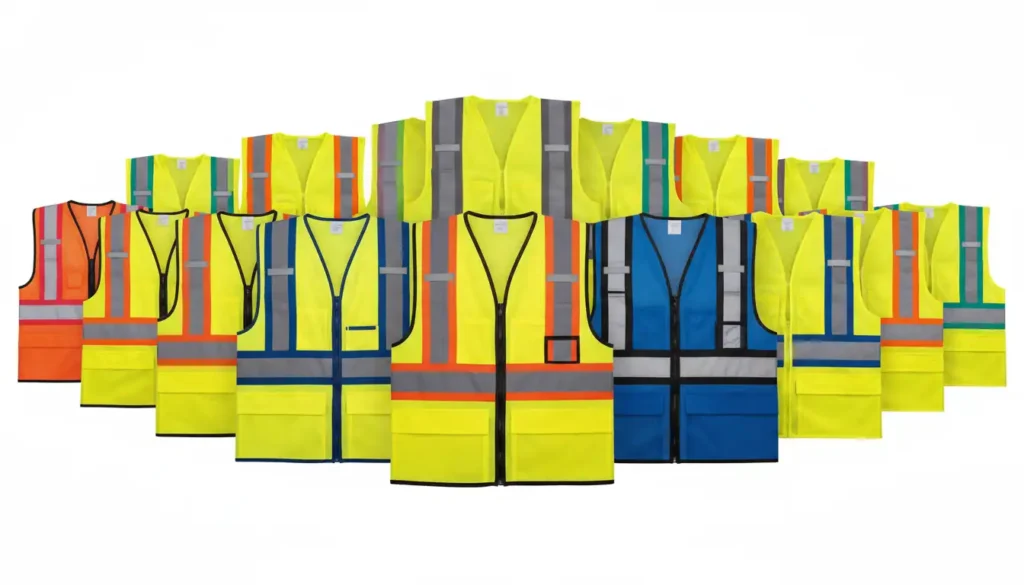
The foundation of the range. Our standard hi-vis vests are available across all compliance classes and in both primary high-visibility colours:
Yellow-Green (Fluorescent Lime) — the most visible colour in daylight conditions and the default for most Australian worksites, road work, construction, and warehousing.
Orange-Red (Fluorescent Orange) — widely used in mining, utilities, civil construction, and traffic management. Also provides differentiation on multi-contractor sites where everyone is wearing lime.
Every standard vest is available in:
- Class D — Day use. Minimum background material and retroreflective tape for work in daylight conditions only.
- Class N — Night use. Enhanced retroreflective tape for work in low-light and night conditions, with reduced background material requirements.
- Class D/N — Day and night combined. Meets the requirements for both Class D and Class N simultaneously. The most versatile choice for worksites that span multiple light conditions.
Closure styles include zip-front, velcro (hook-and-loop), and pull-over (bib) designs. Each has practical advantages:
Zip-front vests provide a cleaner, more tailored look and are preferred for client-facing roles, supervisors, and businesses that want a professional branded appearance. The zipper also provides a secure closure in windy conditions.
Velcro vests are the most common on Australian worksites because they are easy to put on and remove quickly — important on sites where vests may need to be donned and removed frequently. They are also more forgiving across different body shapes.
Pull-over (bib) vests are the simplest construction, most cost-effective, and extremely durable. Favoured for high-turnover environments, casual labour hire, and situations where simplicity and durability outweigh all other factors.
Sizing runs from XS through to 7XL, because one of the most consistent failures in Australian workwear supply is inadequate size range. A safety vest that does not fit is a safety vest that will be left hanging on a hook — defeating its entire purpose.
Heavy-Duty Safety Vests with Tool Pockets
For trades workers, surveyors, field technicians, electrical workers, plumbers, and anyone who needs to carry equipment while remaining hands-free, our heavy-duty safety vest with tool pockets range is purpose-built.
This is a product category where the difference between a cheap generic vest and a properly engineered tool vest is genuinely significant. A cheap vest with pockets added as an afterthought will have weak pocket-to-body attachment, pockets that sag when loaded, and pocket openings that are the wrong size for the tools they are supposed to hold.
Our tool vest range is designed around real Australian tradespeople’s actual workflow:
- Large lower pockets — deep enough for notebooks, folded plans, or small tools
- Pen and pencil loops — positioned where they are actually accessible, not just added because the brief said “loops”
- Ruler and tape holder pockets — reinforced to take the weight of a 5m tape measure or 600mm folding ruler without distorting the vest
- Phone pockets — sized for modern smartphones with touchscreen-accessible window options
- Radio holder loops — compatible with standard two-way radio clip designs used across Australian construction sites
- ID window pockets — clear-front pockets for site access cards, which are now mandatory on virtually all major construction projects in NSW, VIC, and QLD
The fabrics used in our tool vest range are heavier woven materials rather than mesh — because a tool vest needs to support the weight of its contents without stretching, distorting, or tearing at the pocket attachments. These are vests that are meant to work as hard as the people wearing them.
Custom Safety Vests — Your Brand, Your Way
This deserves its own full section, and we cover it in depth in Part Four below. In brief: we offer the most comprehensive custom safety vest service in Australia, from logo printing and embroidery through to full sublimation and custom pocket engineering.
Women’s and Female-Fit Safety Vests
The Australian worksite has changed. Women now make up a significant and growing proportion of workers in construction, mining, utilities, traffic management, and logistics. For too long, the response to this from the workwear industry was to produce a “women’s” vest that was simply a unisex vest in a smaller size — with all the resulting problems of poor fit, excess fabric, incorrect strap positioning, and general discomfort.
Our female-fit safety vest range is properly designed for female body shapes, with:
- Adjusted chest and shoulder proportions that do not gape or bag
- Waist shaping that provides a fitted silhouette without restricting movement
- Correctly positioned reflective tape — because AS/NZS 4602.1 tape placement requirements assume a generic body shape, and a proper female-fit vest ensures compliance without the tape sitting incorrectly
- Sizes that correspond to Australian female workwear sizing conventions, not men’s sizes re-labelled
This is not a concession to a niche market. It is basic respect for a significant part of the Australian workforce, and it is also a practical safety consideration — an ill-fitting vest that workers find uncomfortable or unflattering is a vest that does not get worn consistently.
Winter and Cold-Weather Safety Vests
Southern Australia, alpine regions, early morning winter construction starts across the country — there is a genuine need for high-visibility safety vests that provide thermal protection without compromising visibility or compliance.
Our winter safety vest range includes:
- Padded and quilted hi-vis vests — providing insulation across the core while leaving arms free for full mobility
- Fleece-lined options — softer against the skin for extended wear in cold conditions
- Windproof outer shells — critical for exposed worksites, particularly road and civil construction
- Full Class D/N compliance maintained — because warmth cannot come at the cost of visibility
The most common mistake with winter workwear is buying a bulk cheap padded vest that technically passes as hi-vis but whose fluorescent fabric and tape configuration have not been properly verified against the standard. We do not sell those.
Fire Retardant and Flame-Resistant Safety Vests
For workers in environments where ignition, flame, or arc flash risk is present — petrochemical plants, refineries, mines with explosive atmospheres, electrical utilities, welding operations — a standard hi-vis vest is not sufficient and is in many cases specifically prohibited.
There is an important distinction that workers and safety managers need to understand:
Fire Retardant (FR) fabrics are chemically treated to resist ignition and self-extinguish when a flame source is removed. The FR treatment is applied to the fabric, usually during or after manufacture. Over time and with repeated washing, FR treatments can degrade — which means the garment’s protective performance declines with use.
Flame Resistant fabrics are inherently resistant to burning by virtue of their molecular structure — typically because they are made from inherently flame-resistant fibres like Nomex, Modaflam, or similar technical materials. These fabrics do not rely on chemical treatment and their protective performance does not wash out.
Our flame-resistant and FR safety vest range covers both categories, with appropriate products for different risk levels and budgets, all maintaining hi-vis compliance where required.
Surveyor Safety Vests
Surveying is a profession with very specific workwear requirements that generic safety vest suppliers consistently fail to address properly. Surveyors spend their days carrying and accessing a specific set of tools: field books and notebooks, pens and pencils, ranging rods, flagging tape, GPS equipment, measuring equipment, and increasingly tablets or handheld devices.
The surveyor safety vest from safetyvest.com.au is built around how surveyors actually work:
- Deep, structured pockets designed around field book dimensions
- Multiple pen holders in accessible positions
- Tablet or device pockets with protective backing
- Flagging tape loops positioned on the sides for easy access and deployment
- Durable fabric that withstands constant loading and unloading of pockets across a full working day
- Available in hi-vis compliant versions for road or public land survey work
A surveyor who has used a properly designed surveyor vest will never go back to a standard vest. The productivity difference is meaningful.
Rail Corridor Hi-Vis Vests
Working in or adjacent to the Australian rail corridor is subject to some of the most stringent personal protective equipment requirements on any Australian worksite. The Office of the National Rail Safety Regulator (ONRSR) and individual network operators — including Sydney Trains, Metro Trains Melbourne, Queensland Rail, Arc Infrastructure, and others — apply specific hi-vis requirements that go beyond the base AS/NZS 4602.1 standard.
Rail corridor hi-vis requirements typically mandate:
- A minimum orange or orange-red background colour (not yellow-green) in many corridor environments
- Enhanced retroreflective tape configurations beyond the basic Class D/N requirements
- In some cases, two-piece garments (vest plus trousers or bibs) rather than vest alone
- Specific marking and identification requirements
Our rail corridor safety vest range is designed to meet these enhanced requirements. We also keep pace with individual network operator specification updates — a living compliance landscape that requires active monitoring.
Pink Safety Vests — Compliant and Visible
There is genuine interest in pink hi-vis vests across Australian industries — from breast cancer awareness campaigns and workplace culture initiatives to practical differentiation on sites where large workforces make it useful to colour-code roles or contractors.
The important question is always: are pink safety vests AS/NZS 4602.1 compliant?
The honest answer is nuanced. The standard specifies fluorescent yellow-green and fluorescent orange-red as the approved background colours for compliant Class D/N vests. Pink fluorescent fabric does not appear in the AS/NZS 4602.1 colour specification.
This means that a pink vest cannot be used as the primary compliant hi-vis garment on a worksite that requires AS/NZS compliance. However, pink vests can be used:
- Over the top of a compliant hi-vis vest as a role-identifier
- On worksites or in roles that do not have a mandatory AS/NZS requirement — some retail, event, or community safety roles where the vest is used for identification rather than AS/NZS-mandated visibility
- As part of a workplace initiative where the baseline hi-vis compliance is met by other garments
We stock pink safety vests and are transparent about their compliance status — because selling a product that could create a compliance gap is not something we are willing to do.
Part Four: Custom Safety Vests — The Most Comprehensive Service in Australia
Custom safety vests are one of the fastest-growing areas of our business, and it is easy to understand why. As Australian businesses invest more in brand, culture, and workforce identity, the worksite is increasingly part of the brand experience. How your team looks on-site matters to clients, to subcontractors, and to your own employees.
But custom workwear is also an area where a lot of Australian businesses have been burned — by poor print quality, compliance issues, excessive minimum order quantities, long lead times, or final products that look nothing like the approved proof.
Here is exactly how our custom safety vest process works, and why it delivers results that others cannot match.
Custom Printing Methods — Choosing the Right Technique
Screen Printing is the most cost-effective method for large runs of one or two colours. The ink is applied through a mesh screen and cured onto the fabric. It is durable, vibrant, and works well for clean logo designs with defined colour fields.
Heat Transfer Printing applies a pre-printed film to the fabric using heat and pressure. It is more versatile for multi-colour designs and works across a wider range of fabric types than screen printing. It is the right choice for smaller runs where screen printing setup costs are not justified.
Embroidery applies your logo in thread directly to the fabric. It produces a premium, tactile finish that conveys quality and professionalism. Ideal for supervisors, site managers, and client-facing roles where the vest needs to make an impression. Note that embroidery is not suitable for large designs or fine detail — it works best for logos, crests, and small text.
Sublimation Printing is the highest-capability custom technique available. The design is printed onto transfer paper using dye-based inks, then heat-transferred into the fabric itself — the dye becomes part of the fabric rather than sitting on top of it. This means:
- Full colour, photographic-quality reproduction — no colour limitations
- No peeling, cracking, or fading — the print cannot degrade from the surface because it is the surface
- All-over print capability — the entire vest surface can carry your design, not just a logo placement area
- Gradients, fine detail, and complex artwork are all achievable
Sublimation is the premium option, and it is transformative for businesses that want their workwear to genuinely represent brand quality rather than just comply with a hi-vis requirement.
Colour Matching on Hi-Vis Fabric — Why It Is Harder Than It Looks
One of the most overlooked challenges in custom safety vest production is colour matching your brand colours to hi-vis fluorescent fabric. Your brand may have a specific Pantone reference for its blue, red, or green — but that colour behaves very differently when placed next to, or printed onto, a fluorescent yellow-green or orange background.
Our design team works through colour matching carefully, considering:
- Contrast and legibility — your logo must be clearly visible and readable against the fluorescent background in all lighting conditions
- Ink behaviour on fluorescent fabric — certain colours print differently on fluorescent substrates than on standard materials
- AS/NZS compliance — the background fluorescent material must not be significantly obscured by printed areas, which could reduce the effective background area below the compliance minimum
We provide digital proofs that accurately represent how your branding will appear on the finished vest, and we welcome client feedback before production commences.
No Minimum Orders on Select Lines
One of the biggest barriers to custom workwear for small businesses, sole traders, and start-ups is minimum order quantities. Traditional custom workwear manufacturing runs require large minimums to justify setup costs.
We offer no minimum order quantities on select custom vest lines — particularly for heat transfer and direct-to-garment methods. This means a tradie setting up a new business can order five custom-branded vests for their crew without committing to a 100-unit run. It means a small civil contractor can outfit a six-person crew with properly branded workwear from day one.
Custom Pocket Engineering
Beyond branding, custom vests can be specified with custom pocket configurations — adding or relocating pockets, changing pocket dimensions, adding specific tool holders or loops. This is available on larger production runs and turns a branded safety vest into a genuinely engineered workwear garment.
👉 Design Your Custom Safety Vest Now
Part Five: Australian Compliance — The Complete Guide
Understanding AS/NZS 4602.1 is not just a matter of ticking a regulatory box. It is the framework that ensures your vests actually do the job they are supposed to do — make workers visible and keep them safe.
AS/NZS 4602.1 — What It Requires
The standard defines three performance classes based on use conditions:
| Class | Use Condition | Background Material Area | Retroreflective Tape Area |
|---|---|---|---|
| Class D | Daytime only | Minimum 0.20 m² | Minimum 0.13 m² |
| Class N | Night / low light | Minimum 0.20 m² | Minimum 0.20 m² |
| Class D/N | Day and night | Minimum 0.20 m² | Minimum 0.20 m² |
There is also Class R (Road) — an enhanced specification for workers exposed to road traffic, which requires increased retroreflective tape area and specific tape placement configurations. Class R compliance is mandatory for traffic controllers, road construction workers, and others who work in or immediately adjacent to live traffic lanes.
AS/NZS 1906.4 — The Retroreflective Material Standard
This is the companion standard to AS/NZS 4602.1, defining the performance requirements for the retroreflective tape used in compliant garments. It specifies minimum retroreflective coefficient (RA) values — a measure of how much light is reflected back toward its source at different observation and entrance angles.
There are two primary retroreflective technologies used in safety vests:
Glass bead retroreflective tape uses millions of tiny glass beads embedded in or coated onto a backing material. When light strikes the beads, it is refracted and reflected back toward the source. Glass bead tape is the traditional technology — cost-effective, widely used, and compliant at standard class levels.
Microprismatic retroreflective tape uses precisely engineered microscopic prisms to reflect light back. The prismatic geometry achieves significantly higher retroreflective coefficient values than glass bead — meaning the tape is dramatically more visible at distance, in rain, and at wider viewing angles. Microprismatic tape was traditionally used only in traffic signs and infrastructure, but it is increasingly available in garment-grade tape and represents a meaningful safety upgrade over standard glass bead tape.
For workers in high-risk traffic or night conditions, specifying microprismatic retroreflective tape on your vests is one of the highest-value safety upgrades available.
State and Industry-Specific Requirements
Beyond the base AS/NZS standards, there are industry and state-specific requirements that overlay the national framework:
Mining (all states) — State mining regulations require AS/NZS 4602.1 compliant garments and often mandate orange-red rather than yellow-green in specific areas. Underground operations have additional lighting and visibility considerations.
Rail (national via ONRSR) — Enhanced specifications beyond AS/NZS 4602.1, with network operator-specific requirements for colour, tape configuration, and garment type.
NSW Construction — SafeWork NSW enforces AS/NZS 4602.1 on construction sites. The Workplace Health and Safety Act 2011 (NSW) and the Work Health and Safety Regulation 2017 set the framework.
Road Work (all states) — Class R compliance is mandatory for traffic-exposed workers. Traffic control plans typically specify hi-vis requirements as a condition of the plan approval.
Courier and Delivery — Workers who deliver or collect from regulated sites, or who operate on public roads with traffic exposure, are subject to hi-vis requirements that vary by state and operator.
Part Six: Choosing the Right Safety Vest for Your Industry
Selecting the correct safety vest is not just about buying the standard hi-vis vest. The right vest depends on your specific industry, your specific worksite conditions, your workers’ roles, and the applicable compliance requirements. Here is a condensed decision guide:
Construction and Civil Works
What you need: Class D/N vest (day and night capability covers all shift patterns), woven or mesh fabric depending on climate, zip or velcro closure.
If workers are traffic-exposed: Class R compliance is required.
If workers carry tools: Tool pocket vest over or in place of standard vest.
Recommended: Our standard Class D/N vest range in zip-front or velcro, with optional tool pocket configuration.
Road and Traffic Control
What you need: Class R compliant vest as a minimum. Orange-red is often specified for traffic controllers to differentiate from road workers in yellow-green. Velcro closure for rapid donning and doffing at traffic control points.
Key consideration: Class R requires specific tape placement — check that your vest is explicitly marked as Class R, not just Class D/N.
Mining and Resources
What you need: Orange-red hi-vis (preferred or mandated in most mining environments), Class D/N compliance, fire retardant or flame-resistant options for sites with ignition risk.
Key consideration: Different mining operations have site-specific PPE requirements that supplement the base standard. Confirm the specific requirements for each site before ordering.
Warehousing and Forklift Operations
What you need: Class D vests are typically sufficient for fully indoor, lit warehouse environments. The fluorescent background is primarily for identification in a lit environment rather than retroreflection. Comfort and breathability are particularly important for workers doing physical activity across a full shift.
Key consideration: If the warehouse has outdoor receiving areas or low-light zones, Class D/N is the safer specification.
Surveying and Field Work
What you need: Surveyor vest with tool pocket configuration. If working on public roads or rail, the appropriate Class R or rail corridor specification applies over and above the tool configuration.
Agriculture and Farming
What you need: There is genuine demand for what is sometimes called a farmer’s vest — a hi-vis vest designed for agricultural environments where the hi-vis serves as both a visibility garment and a practical working vest with pockets. Durability, wash performance, and pocket utility are the priority criteria.
Part Seven: The Safety Vest Sizing Guide — Getting the Right Fit
A safety vest that does not fit properly is a safety vest that will be worn incorrectly, modified by the worker (often in ways that reduce compliance), or simply not worn at all. Getting the right size matters.
Standard Sizing Reference
| Size | Chest Circumference | Typical Build |
|---|---|---|
| XS | 80–88 cm | Small frame, youth |
| S | 88–96 cm | Average female, slim male |
| M | 96–104 cm | Average male |
| L | 104–112 cm | Larger male, broader female |
| XL | 112–120 cm | Large male |
| 2XL | 120–128 cm | X-Large |
| 3XL | 128–136 cm | XX-Large |
| 4XL–7XL | 136 cm+ | Extended sizes |
Key Fit Considerations
Length: A safety vest should cover the torso from shoulder to at least the top of the hips. It should not ride up when the worker raises their arms — this is particularly important for workers who perform overhead tasks, as a vest that rides up exposes the lower back and can interfere with other PPE.
Shoulder fit: The shoulder seams should sit at or near the actual shoulder point, not drooping down the upper arm. A vest with drooping shoulders will restrict arm movement and look unprofessional.
Chest and body fit: There should be enough room to comfortably fit over the base layer being worn — whether that is a work shirt in summer or a jacket in winter. Do not size a vest purely based on the worker’s T-shirt size.
Female sizing: As discussed, female workers should select from the female-fit range rather than standard unisex sizing. Our team can advise on conversion between standard workwear sizing conventions.
Part Eight: Safety Vest Colour Guide — Orange vs Yellow, and When Each Applies
The two primary hi-vis colours used in Australian safety vests — fluorescent yellow-green and fluorescent orange-red — are both AS/NZS 4602.1 compliant, but they have different practical applications and visibility characteristics.
Fluorescent Yellow-Green (Lime)
This is the most common hi-vis colour on Australian worksites. It has the highest daylight visibility of any colour — it sits at the peak of the human eye’s photopic sensitivity curve, meaning the eye detects it most readily in daylight conditions.
Yellow-green is the default choice for construction, warehousing, logistics, utilities, and most general worksite applications.
Fluorescent Orange-Red
Orange has lower daylight visibility than yellow-green in pure photometric terms, but it has significant practical advantages in specific contexts:
- Differentiation on large sites — when all workers are wearing yellow-green, it becomes difficult to identify different roles or contractors. Introducing orange for specific roles (supervisors, visitors, specific trades) creates instant visual differentiation.
- Mining industry convention — orange-red is the default colour for many mining operations, both for tradition and for the practical reason that yellow-green can blend with certain geological environments.
- Rail corridor — orange is specified in many rail corridor environments where yellow-green may be harder to distinguish from infrastructure elements.
- Traffic control — orange is widely specified for traffic controllers in some states.
When to Use Both
Some worksites use yellow-green as the baseline for all workers and orange as the identifier for supervisors, safety officers, or specific contractor groups. This creates a clear, instantly readable hierarchy of site roles that improves worksite management.
Part Nine: The True Value of a One-Stop Safety Vest Solution
Fragmented workwear procurement is one of the most consistently underestimated operational costs in Australian business. When you source safety vests from three or four different suppliers, the costs that accumulate are significant:
Administrative overhead — multiple supplier relationships means multiple purchase orders, multiple invoices, multiple payment runs, multiple delivery tracking items. For a business processing 20 safety vest orders a year, this overhead can represent multiple hours of administration per month.
Quality inconsistency — when your standard vests come from one supplier, your custom-branded vests from another, and your speciality items from a third, quality variations between them create a workforce that looks uncoordinated on-site. Different shades of yellow-green, different tape widths, different cut profiles — these seem minor but they add up to an unprofessional overall impression.
Compliance gaps — different suppliers have different levels of compliance knowledge. Relying on multiple suppliers to collectively ensure your workforce is compliant across all roles is a risk management problem waiting to become an incident investigation problem.
Reordering friction — when you need to replace worn or damaged vests quickly, having to re-engage multiple supplier relationships and cross-reference specifications creates delay. Delay means workers without compliant PPE.
safetyvest.com.au eliminates all of these problems. One supplier. One relationship. One quality standard. One compliance framework. One call when you need to reorder.
Part Ten: Trusted by Australian Businesses — What That Actually Means
The phrase “trusted by Australian businesses” gets used a lot in workwear marketing. Here is what it means in practice at Sands Industries:
We answer the phone. Our NSW-based support team is accessible, responsive, and knowledgeable. When you call with a compliance question, a custom order enquiry, or a delivery issue, you speak to someone who actually knows our product range and can give you a real answer.
We deliver what we promised. The product you approved in the proof is the product you receive in the box. The vest you ordered last year matches the vest you order this year. This sounds like a minimum expectation — but it is an expectation that a significant portion of the Australian workwear market fails to meet.
We are transparent about what our products can and cannot do. We will tell you when a pink vest is not a compliant Class D/N vest. We will tell you when a Class D vest is not sufficient for a rail corridor environment. We will tell you when your custom logo placement could create a compliance issue and work with you to find a solution that achieves both compliance and brand objectives.
We keep pace with a changing compliance landscape. AS/NZS standards are periodically reviewed. State and territory regulations evolve. Industry-specific requirements change as new technology and new evidence emerges. Our team actively monitors this landscape so our customers do not have to.
We service all of Australia. Fast shipping to every state and territory means your worksite in regional Queensland, Western Australia’s Goldfields, or suburban Adelaide gets the same service as a Sydney CBD project.
Conclusion: The Safety Vest Decision Is a Safety Decision — Make It With the Right Partner
Every purchasing decision your business makes has consequences. Most of them are minor and recoverable. A poor-quality safety vest decision is different. It can put workers at risk, expose your business to compliance liability, and undermine the safety culture you have worked to build.
Sands Industries — safetyvest.com.au — is the partner that takes that responsibility seriously. As a manufacturer, we control quality. As a national supplier, we deliver reliably. As a custom solution provider, we give your brand the professional representation it deserves on every worksite in the country. As a compliance resource, we help you navigate an increasingly complex regulatory landscape.
We are not the cheapest option in the market. We do not try to be. We are the best option — the one that delivers consistent quality, genuine compliance, and a partnership that grows with your business.
If you are ready to work with Australia’s best safety vest provider — whether you need 5 vests or 5,000, standard stock or full custom, one-off supply or ongoing managed replenishment — we are ready to talk.
Get Started Today
🟡 Design Your Custom Safety Vest →
Browse the full range: safetyvest.com.au
Call our NSW team:
- +61 4415 9165
- +61 477 123 699
Visit us: Unit 27/191 McCredie Road, Smithfield NSW 2164
Fast Australia-Wide Shipping | Local NSW Support Team | AS/NZS Compliant Products
Sands Industries (safetyvest.com.au) — Australia’s trusted safety vest manufacturer, supplier, and custom solution provider. ABN: 30 629 811 383 | ACN: 629 811 383 Serving worksites across NSW, VIC, QLD, WA, SA, TAS, ACT and NT.